With the Presidential election fast approaching, I thought I would put down my thoughts about why I won’t be voting. Simply put, my vote does not mean as much as MTV tries to make it out to mean, and I don’t feel that I should have to choose between the lesser of two evils. My friend Regan has hashed much of this out in a post on his blog, but I feel the need to speak on it as well. First, read the following essay from Christianity Today, which expresses the same sorts of things I am thinking, only more eloquently. It is a little long for a blog, but worth the read.
********************************
Salt-and-Pepper Politics:
Choosing between candidates whose consciences are too clean
By Andy Crouch
October 2004, Vol. 48, No. 10, Page 108
Copyright © 2004 Christianity Today.
Some things were meant to be together. At least, that's what I learned somewhere along the way about table manners. Even if you just want the salt, etiquette requires that you ask for the salt and pepper. In the words of Miss Manners, "they get lonely if separated."
Ancient Israelites, as far as I know, didn't even have a word for pepper, but they did have the twin words mishpat and tsedaqah, which most English Bibles translate as justice and righteousness. "Endow the king with your justice, O God, the royal son with your righteousness" (Ps. 72:1)—justice and righteousness go together just like king and royal son. Prophets and psalmists thought in twos: throne and kingdom, establishing and upholding, justice and righteousness. Mishpat and tsedaqah. Just as salt and pepper belong together on a well-set table, justice and righteousness belong together in a nation. Mishpat and tsedaqah show up together more than 30 times in the Hebrew Bible, nearly always in a political context. Because justice and righteousness are the foundation of God's throne (Ps. 89:14), they are also the "measuring line" and the "plumb line" (Isa. 28:17) of earthly thrones.
Which brings us to Democrats and Republicans, and to why I will be voting this November with, well, fear and trembling.
Justice, in biblical terms, is more than equal treatment under the law—it involves putting power at the service of the powerless and wealth at the service of the poor. My friends who care about justice argue that Democrats have spent 50 years advocating for the vulnerable: the poor, the sick, the youngest, the oldest. And though the party of the powerless also has a curiously strong appeal among the elites of Hollywood and Manhattan, on the whole my friends are probably right.
Righteousness, meanwhile, is more than honesty and fair dealings—it requires the alignment of our lives with God's original good intentions for creation. Like justice, righteousness in a nation especially benefits the poor and powerless, who cannot insulate themselves from the effects of sin. My friends who care about righteousness argue that Republicans have held the line against values that come straight from the maw (or the mall) of individualistic consumerism, where pleasure and preference reign. And while the party of moral character raises lots of money from people whose only interest is making the world safe for consumerism, I can't argue with these friends either.
To make matters worse, each presidential candidate has blind spots even in his area of putative strength. John Kerry declines to see that abortion is not a matter of private morality but of public justice for utterly vulnerable human beings. (Bizarrely, he justifies his position by saying that government must keep out of people's bedrooms. Abortions do not generally happen in bedrooms.) Any public official who professes Catholic faith and is as enthusiastically pro-choice as Kerry does not have, in the words of the Catholic bishops, "a well-formed conscience."
Yet our President's conscience also seems too clear to be true. Asked a simple and predictable question at an April 2004 press conference—to name his greatest mistake since September 11, 2001—he couldn't answer, saying, "I don't want to sound like I've made no mistakes. I'm confident I have. I just haven't—you just put me under the spot here, and maybe I'm not as quick on my feet as I should be in coming up with one." Is it too much to ask that the most devout President in recent history have a more concrete response to a question about his own limitations?
Such is the state of our presidential politics: an evangelical President flummoxed at any suggestion of his own fallibility, and a Catholic candidate who sidesteps his church's teaching authority. And in both our political parties, concern for justice often serves as cover for self-justification; righteousness curdles all too quickly into self-righteousness.
So I've decided that my own vote will be less about endorsing a platform or person than discerning the potential for change—in biblical terms, for repentance. Is it more likely that the party of justice can repent of its indifference to righteousness, or that the party of righteousness can repent of its deafness to justice? I have to choose one, but I will pray for both. Some things aren't meant to be separated.
********************************
Neither side has it all together, and both leave out one aspect of life that is vital—justice and righteousness (which I equate with standards of holiness). Just because Bush is against the hot button topics like gay marriage and abortion doesn’t mean he has done much or plans to do much to help out the scenario in which the rich get richer and the poor get poorer. Kerry may care about the oppressed, but does his laisse faire attitude about conduct agree with the lifestyle that I believe God is calling His creation to live? So I choose not to vote. And until a candidate shows that he cares just as much for the oppressed and the poor as he does about making sure that our freedoms line up with God’s standards I will not cast my vote.
For all of you who say that I can’t complain or have an opinion about the state of things because I choose not to vote, I refer you to our Bill of Rights. Just as I have the right to vote (or not to vote) I have to right to think and speak (or not to speak).
Let me know what you think.
Give some qualities of candidates you would endorse.
Tell me why you are voting and why you have chosen a particular candidate.
Monday, October 18, 2004

Friday, October 15, 2004
TV Pet Peeves
I was watching a thrilling college football game between Miami and Lousville. Then what happens? My cable goes out. No, not all of it. Just the sport, music, and Turner channels. So instead of watching this offensive explosion I had to sit through Baseball. What a joke. You would think that for $45 a month I could get better service. Nope.
************************
We also found out that our company (Charter) was sued for driving up prices through line fees and other hidden costs. A class action suit was brought against them and now I might be getting a year of high speed internet access. Pretty sweet.
************************
For a while now, I have noticed a disturbing trend on ESPN2. At the outset, they were supposed to be a station for “alternative” sports, which at the time was “extreme” sports. Now that “extreme” has become normal, they have gone to other sorts of programming. Billiards, Hunting and Fishing, even Poker have entered into the daily schedule. I don’t have a major problem with this sort of broadcast. But the last few years have seen a rise in things that are not sports, but merely competitions. The National Spelling Bee and dog shows have headed up the list. I suppose there is a place for these shows on TV, but not on my ESPN. How is the Spelling Bee going to get better ratings than something else, say the #1 sport in the world, soccer?
Well, have I put up with it for a few years, but enough is enough. I turned on the TV yesterday, and ESPN2 was showing the National Scrabble Tournament Finals. You read correctly. Scrabble was being televised. Two nerds were dukeing it out for a $25,000 purse. They even had insights into training such as the 4-6 hours a day that the contestants spent learning the 120,000 acceptable words in Scrabble. What a joke. Sure, they may be way smarter than me. And, perhaps intelligence should be praised over strength and agility. But seriously, does it have to be on ESPN? I recommend we start a new station dedicated to televising this crap. Spelling Bees, Dog Shows, Scrabble, Firefighter competitions, Lumberjack wierdness, even Poker (which I love to watch and play) should not be on a “sports” network. Get the hell off of my ESPN and stick the Game Show network, or Animal Planet, or wherever else you can show this crap. But leave the sports on ESPN. Please.
************************
We also found out that our company (Charter) was sued for driving up prices through line fees and other hidden costs. A class action suit was brought against them and now I might be getting a year of high speed internet access. Pretty sweet.
************************
For a while now, I have noticed a disturbing trend on ESPN2. At the outset, they were supposed to be a station for “alternative” sports, which at the time was “extreme” sports. Now that “extreme” has become normal, they have gone to other sorts of programming. Billiards, Hunting and Fishing, even Poker have entered into the daily schedule. I don’t have a major problem with this sort of broadcast. But the last few years have seen a rise in things that are not sports, but merely competitions. The National Spelling Bee and dog shows have headed up the list. I suppose there is a place for these shows on TV, but not on my ESPN. How is the Spelling Bee going to get better ratings than something else, say the #1 sport in the world, soccer?
Well, have I put up with it for a few years, but enough is enough. I turned on the TV yesterday, and ESPN2 was showing the National Scrabble Tournament Finals. You read correctly. Scrabble was being televised. Two nerds were dukeing it out for a $25,000 purse. They even had insights into training such as the 4-6 hours a day that the contestants spent learning the 120,000 acceptable words in Scrabble. What a joke. Sure, they may be way smarter than me. And, perhaps intelligence should be praised over strength and agility. But seriously, does it have to be on ESPN? I recommend we start a new station dedicated to televising this crap. Spelling Bees, Dog Shows, Scrabble, Firefighter competitions, Lumberjack wierdness, even Poker (which I love to watch and play) should not be on a “sports” network. Get the hell off of my ESPN and stick the Game Show network, or Animal Planet, or wherever else you can show this crap. But leave the sports on ESPN. Please.
Thursday, October 14, 2004
Pop-up Debates
I watched the final presidential debate last night. It was what I expected. A lot of mudslinging, a lot of impugning one another’s past actions, and a lot of inflated statistics. The whole time I watched, I wondered, “Is that true?” When they are talking about trillions of dollars it boggles my mind and I wonder if such a figure could be accurate.
This led me to an idea. I always enjoyed watching pop-up video on VH1. You know, interesting, but mostly useless facts about a particular video, the artists, the sets, etc. What if we had pop-up debates. That way, when John Kerry says that Bush’s tax cuts are putting us 600 trillion dollars in debt, a little balloon pops up and says, “Actually, it is only 1 trillion.” Or when Bush says that Kerry voted for extra taxes 98 times, a balloon pops up and says, “Though true, 80 of them were for alcohol, cigarettes, and other vice taxes.”
ABC did have a fact checker at the end of the debate who set some things straight. But it was too little too late for me. I like instant gratification, and would like to know who is lying, who is skewing facts, and who is just a moron. But in order to know such things, I would have to spend way more time on the internet than I already do. And I just have no desire to do that.
This led me to an idea. I always enjoyed watching pop-up video on VH1. You know, interesting, but mostly useless facts about a particular video, the artists, the sets, etc. What if we had pop-up debates. That way, when John Kerry says that Bush’s tax cuts are putting us 600 trillion dollars in debt, a little balloon pops up and says, “Actually, it is only 1 trillion.” Or when Bush says that Kerry voted for extra taxes 98 times, a balloon pops up and says, “Though true, 80 of them were for alcohol, cigarettes, and other vice taxes.”
ABC did have a fact checker at the end of the debate who set some things straight. But it was too little too late for me. I like instant gratification, and would like to know who is lying, who is skewing facts, and who is just a moron. But in order to know such things, I would have to spend way more time on the internet than I already do. And I just have no desire to do that.
Sunday, October 10, 2004
The Butterfly Effect

Carrie and I watched the movie “The Butterfly Effect” the other week, and I am just now getting my thoughts out about it. The idea comes from “The Chaos Theory” and basically attempts to describe how small and apparently insignificant incidents can set in motion a chain of events with far reaching consequences. As this concept relates to the movie, every time the main character went back and changed his past, the future looked much different. Though some things were improved, others were affected for the worse. Anyway, decent movie. Kind of interesting.
But it got me thinking. If taken seriously, the proponents of this theory postulate that even the flap of a butterfly's wings in Central Park could ultimately cause an earthquake in China. That blew me away. Though most dismiss this concept as farfetched and without basis, I thought I would spend some time spiritualizing it. I considered how many people I ran into each day. Some I acknowledge perhaps with a nod, a smile, maybe even a word. Others I blow by uninterested in their lives. And still others I spend a large portion of my time, investing my life into theirs. And what are the consequences? It seems that my dismissal of people has more impact than my investment, at least I feel that way sometimes. I spend hours with the kids in my youth group and then find out that they are involved in things that will only lead to pain and heartache. Meanwhile, I ignore other kids and who knows if it has any impact on them.
At the football game Friday night I saw two teenage girls holding hands and kissing. My teenagers just looked with disgust. I did nothing but continued to engage them in pointless conversation. But what if, instead of focusing on these kids that I know so well and am trying to impact, I had spent that time reaching out to their classmates that are ostracized? By ignoring them, and so many other people do I perpetuate their destiny in life to be cast out? What if a simple “Hello,” or some other act of love and kindness triggered a spiritual awakening in them?

I guess in the end, I want to be the butterfly – flapping my wings, not to cause an earthquake and devastation, but bringing renewal, restoration, and reconciliation. When my wings flap, may it cause the same ripples that Jesus’ actions did: “The Spirit of the Lord is upon me, for He has anointed me to preach the gospel to the poor, to proclaim the release of the captives, and recovery of sight to the blind, to set the oppressed free, and to proclaim the year of the Lord’s favor” (Luke 4:18-19).
Friday, October 01, 2004
The Big Debate
So, I watched the presidential debate last night.
All I heard from Bush was, “I don’t see how you can lead when you say, ‘Wrong war, wrong time, wrong place.’ What message does that send?”
All I heard from Kerry was, “We should not have brought war to Iraq.”
Now, I have not kept up completely with it all, and I suppose that these issues are important to Americans, but not as much for me. I tuned in hoping they would discuss gay marriage, stem cell research, the environment, our social problems, etc. But I found out at the end that these “domestic” issues will be discussed in two weeks at the 3rd debate. I was more than a little displeased. But, it was interesting nonetheless.
A couple of observations. Both men came out swinging at the opponent, but refused to answer for themselves. One candidate would make an accusation at the other, and instead of doing a good, clear job of answering the accusation, he would side step it and return fire. Not what I was hoping to see.
Second, Kerry made it clear that Bush needed to humble himself and seek some forgiveness from various places. That, I agree with. Leadership books will tell you to always have a strong front, and not show weaknesses. I believe it is quite the opposite. If leaders want respect, they must seek forgiveness when they fail. If they make bad decisions, then the must come clean and say, “I screwed up.”
I believe that the inability to be humble is the very thing wrong with politics. Too much side stepping and spin doctoring. Maybe they teach that sort of thing at Ivy League schools. And maybe the American public wants a strong front of a person that they see no flaws in. And maybe we don’t want to show weaknesses to other nations. But if we want to lead in such a way that brings people together, I believe honesty and humility must be at the forefront.
Monday, September 27, 2004
Let me begin by saying that I appreciate all the comments I have gotten thus far about my approach to Scripture. You have been insightful and challenging which is the exact reason I put it out there. I was not exactly trying to “get your goat” as Shannon said, but at the same time I was interested in seeing how a controversial view like that would be handled. I am searching for an approach that can answer the contradictions found in the Bible in a reasonable way (I am sorry, but many of those books out there like Hard Questions from the Bible or whatever just don’t do it for me). I am still working on an approach to the Bible that accepts it as God’s Word, but allows for human influence. Regan posed the question that really is the chink in the armor of such a view: “How do you determine what is from God?” Once you start relegating certain parts of Scripture to human invention, what keeps you from dismissing the Bible as a whole? My anonymous contributor talked about undermining the text leading to “walking on shifting sand”, or as I always have been taught, “heading down a slippery slope.” And all of those things are considerations that must be handled. So let me see what I can do.
I hold that there are tensions in the Bible that fall into one of two categories. First, is the obvious—contradictions. If at one point the Bible says the sky is Blue, and at another point it says that the same time and place it was lavender, we have a contradiction. We see them in various places—differing Gospel accounts, differing numbers in the OT (sizes of armies, shekels, etc.), differing accounts of who actually killed Goliath. For the most part, we can reconcile them by citing sources, points of view, etc. In other words, we blame the human element in Scripture for that. The other category we call paradoxes—two things that are seemingly at odds, but that are true. God’s grace and judgment, forgiveness and holiness, the Fear of Yahweh and fellowship with Him. These are harder to explain (being that they are paradoxes), but we see that they can exist together.
Here is where the problem arises for me—when contradictions and paradoxes overlap. We know that God is love, but he is also holy and cannot stand to be around the profane. Thus, we see the destruction of Sodom and Gomorrah, the Flood, etc. We say, yes they got what they deserve for living a life of evil. But what about the Canaanites? What did they do to deserve being ousted from their homeland? Why were they to be completely wiped out? Just so the Israelites could have a home? I have to say, that bothers me a little. I see this sort of mentality grating against both God’s love and His holiness. In other words, the narrative seems to be contradicting what the rest of Scripture reveals about God. One might say, well this Scripture says something different about God and must be accepted too. I will concede such a point, but ask, “What are we to learn about God from this? Is He arbitrary, biased, cruel?”
I suppose a lack of sufficient answer up to this point led me to considering my view of the Bible that perhaps God did not order the annihilation of the people of Canaan. And if that is the case, I wondered what else had the writers atributed to Yahwe that might not have been. Maybe that was the wrong way to go, but I thought I would go somewhere and see what I found. I found that I could accept it there, but that I did have that nagging voice saying, “Who makes you the arbiter of Scripture?” So I throw the question back to you all: “How do you determine which parts of Scripture are human and which are divine, or do you not accept the human influence at all?” And for those that are wondering, the answer to such a question will determine whether I accept the Bible as the revelation of God for salvation, faith, etc. But it would be nice to know! :)
Monday, September 20, 2004
Questions
So, I was watching the TN FL football game Saturday night and all I can see are those ugly orange shoes that the TN players are wearing. But that isn’t the point of this post.
Anyway, right before the second half starts, the sideline reporter says to Zooke, the head coach of the Gators (paraphrased with my own sarcasm added), “So, your quarterback is playing well. Are you going to run the ball at all in the second half?” What is the coach supposed to say? “No, we are going to pass on every down. We only gained 54 yards on the ground in the 1st half. The running back had his chance. Too bad.” Of course not. Even if they were going to pass on every down, they wouldn’t tell the sideline reporter.
It leads me to a pet peeve of mine. Stupid questions.
You hear them on the sidelines of sporting events—“Coach why did you lose by 45 points tonight?” The answer is usually obvious—the other team is way better than us, and we can’t play offense or defense.
You hear them in the Miss America pageants—“If you could wish for one thing for the world, what would it be and why?” The answer is always world peace.
You hear them during interviews—“So, are you for the war in Iraq or not? If you say “yes” you are a warmonger, if you say “no” you think it is great to have a homicidal maniac in power.
You hear them from people you know—“How are you doing?” They don’t really want to know; they’re just being cordial.
Stupid questions lead to stupid answers and stupid conversations.
What happened to good questions? Questions that make you think; questions that don’t have pat answers; questions that actually mean something. A good lesson writer can ask those questions that get the people thinking and responding. But those questions are hard to come by.
I see that Jesus was always asking good questions. Normally when people posed questions to him, he answered in kind. Their questions were meant to trap Jesus or paint him in a doctrinal corner. But Jesus made them do the thinking. He asked the good questions. Socrates asked some good questions and made people think about their own presuppositions before he tipped his hand.
Imagine, someone making a statement, say on a forum or blog, that you disagree with and instead of reacting, you asked some insightful questions to mine out some more of their thinking and the things that lie behind their beliefs.
Imagine, someone is caught in a sin and instead of running to an indictment first asking how something might have happened, or perhaps what you could do for the injured party or to restore the offending party.
Imagine someone complaining about some arbitrary thing in the church, and instead of taking sides asking questions to see what lies behind their complaint.
Tuesday, September 14, 2004
Approaching the Bible
I finshed my response, and couldn't wait. So here it is.
First off, let me say that I am not dismissing any part of the Bible. However, I understand some parts to be human invention, perhaps not of God’s direction. And Shannon is right—God chose to leave them in. Maybe for theology; maybe to understand humanity better or differently. I am not sure. But that is something to discuss. What I am proposing is not new, nor is it an attempt to say that those before me did not properly understand the Bible. I do not have an “edge” on understanding God that others (far smarter than me) did. Many others have asserted and believed the same things I do which at certain points agrees with and at other points disagrees with those who went before. That is the nature of Scripture—it is so rich and deep that one man or community will never grasp it. Yet each generation of Christians struggles with deciphering just what this corpus of literature meant and now means. With that in mind, we struggle forth.
Let me try to lay out again what I am proposing. Regan said, “How can you tell what is biased?” I would reply, “All of it is biased.” It has all been written by men of faith advancing their own view of God, religion, and the world. I don’t discount the work of the Spirit, but in the end, men are still writing and I have faith that God is guiding the process. Now Tom worries that this view dismisses God’s “commandments”. This is of course, not the case. I don’t seek to dismiss morality or God’s call to holiness. But we all know that there are things in the Bible that are very situational that we no longer (or at least should no longer) adhere to. For example, Corinthians is full of situational edicts or “commandments.”
“Any woman who prays or prophesies with her head uncovered disgraces her head.” (1 Cor. 11:5a)
“Women should be silent in the churches. For they are not permitted to speak, but should be subordinate, as the law says.” (1 Cor. 14:34)
I doubt many of your churches refuse women the right to participate publicly in the worship service. And when they do, are their heads covered with a veil? I doubt it. Yet, such practices undermine the Scripture. Though I am challenged that I toss away certain parts of the Bible, we all do it frequently. How about all of the Levitical laws? What about those “commandments”? We dismiss them as archaic or not applicable to the New Covenant. The reason we take such an approach to Scripture is because of the human element that is inherent in the Bible. Even Paul admits that his own preferences have made it into the Scriptures. 1 Corinthians 7:12 states, “To the rest I say—I not the Lord—that if any believer…” Clearly Paul’s own understanding and application of God’s commandments made it into the letter.
My point is simple—we all interpret the Bible according to our current situation. If a particular passage or commandment seems based on a specific context, we ignore it or find ways to reapply it. I am doing the same sort of thing. The OT is full of polemic—stories intentionally crafted to further a point of view or to discount a point of view. For example, the creation accounts in Genesis 1-2 are more a response to the polytheistic ideologies that ran unopposed in the Ancient Near East than they are an exact account of what happened. If that is the case, than why couldn’t other material from the OT be along the same vein? Why couldn’t the Israelites justify their wars by assuming God commanded them? All I am saying is that some of the “Thus saith Yahweh” phrases may not be from God.
We can talk about the implications of such a view. Like, “How do we know what is from God?” Or, “Were the Israelites then wrong for doing such things?” Or even, “How can I trust my Bible?” But I will save that for another day.
Let the flogging commence.
First off, let me say that I am not dismissing any part of the Bible. However, I understand some parts to be human invention, perhaps not of God’s direction. And Shannon is right—God chose to leave them in. Maybe for theology; maybe to understand humanity better or differently. I am not sure. But that is something to discuss. What I am proposing is not new, nor is it an attempt to say that those before me did not properly understand the Bible. I do not have an “edge” on understanding God that others (far smarter than me) did. Many others have asserted and believed the same things I do which at certain points agrees with and at other points disagrees with those who went before. That is the nature of Scripture—it is so rich and deep that one man or community will never grasp it. Yet each generation of Christians struggles with deciphering just what this corpus of literature meant and now means. With that in mind, we struggle forth.
Let me try to lay out again what I am proposing. Regan said, “How can you tell what is biased?” I would reply, “All of it is biased.” It has all been written by men of faith advancing their own view of God, religion, and the world. I don’t discount the work of the Spirit, but in the end, men are still writing and I have faith that God is guiding the process. Now Tom worries that this view dismisses God’s “commandments”. This is of course, not the case. I don’t seek to dismiss morality or God’s call to holiness. But we all know that there are things in the Bible that are very situational that we no longer (or at least should no longer) adhere to. For example, Corinthians is full of situational edicts or “commandments.”
“Any woman who prays or prophesies with her head uncovered disgraces her head.” (1 Cor. 11:5a)
“Women should be silent in the churches. For they are not permitted to speak, but should be subordinate, as the law says.” (1 Cor. 14:34)
I doubt many of your churches refuse women the right to participate publicly in the worship service. And when they do, are their heads covered with a veil? I doubt it. Yet, such practices undermine the Scripture. Though I am challenged that I toss away certain parts of the Bible, we all do it frequently. How about all of the Levitical laws? What about those “commandments”? We dismiss them as archaic or not applicable to the New Covenant. The reason we take such an approach to Scripture is because of the human element that is inherent in the Bible. Even Paul admits that his own preferences have made it into the Scriptures. 1 Corinthians 7:12 states, “To the rest I say—I not the Lord—that if any believer…” Clearly Paul’s own understanding and application of God’s commandments made it into the letter.
My point is simple—we all interpret the Bible according to our current situation. If a particular passage or commandment seems based on a specific context, we ignore it or find ways to reapply it. I am doing the same sort of thing. The OT is full of polemic—stories intentionally crafted to further a point of view or to discount a point of view. For example, the creation accounts in Genesis 1-2 are more a response to the polytheistic ideologies that ran unopposed in the Ancient Near East than they are an exact account of what happened. If that is the case, than why couldn’t other material from the OT be along the same vein? Why couldn’t the Israelites justify their wars by assuming God commanded them? All I am saying is that some of the “Thus saith Yahweh” phrases may not be from God.
We can talk about the implications of such a view. Like, “How do we know what is from God?” Or, “Were the Israelites then wrong for doing such things?” Or even, “How can I trust my Bible?” But I will save that for another day.
Let the flogging commence.
Hello? Anybody there?
Many of you might be wondering: “Where did Sam go?” or “What happened to him?” Now I was supposed to be short on blog posts because I was in Michigan and unable to get internet access. But that is not the case. We didn’t go to Michigan because Carrie and Elijah just could not make the trip. So, we stayed at home, and I recovered from sickness, and we sort of vegged out hoping to get better. But I am back now (to normal life not from somewhere) and will attempt to engage you, my faithful readers better. I never answered the questions from my last post about the nature of the Biblical literature. I plan to tomorrow. So stay tuned.
Blog ya tomorrow.
Blog ya tomorrow.
Thursday, September 02, 2004
Pacifism and the Bible
I know I don’t have a great following yet on my blog, but for those who come regularly, you will notice that I haven’t had much to say. To be honest, anything that I have had to say has gone on the forums at the GLCC Alumni site. Even then I haven’t had much time to say some of the things that I have wanted to. So, I thought I might make some observations about what I have read.
I have a few things to say about the nature of God as revealed in the Bible. The Pacifism thread of the Alumni Forum contained much discussion about God always being right, and God commanding the Israelites to do some things, and us questioning whether these were right and so forth. It seems to me that the reason that these texts in which the Israelites are commanded to destroy entire nations are so difficult is because they grate against what we consider to be the unchanging nature of God. We consider Him to be Good, Loving, etc. How could a God of that character order His chosen nation to annihilate other members of His creation? The answer, in my opinion, does not lie in the character of God but in the lens with which we interpret the Bible.
Let me introduce a concept that might be considered heretical or liberal—what if God didn’t command them? What if in these texts we have Nationalistic polemic, or what I might call Divine Approval of Israel’s actions? In other words, what better way to justify your actions than by claiming that God has commanded and ordained them? We see it throughout history—the Crusades, the founding of our country, the enslavement of entire people groups, and every other “holy war” that has been undertaken. I believe the example for such actions stems from the Biblical corpus.
This view, though perhaps controversial, ends discussions about war ever being justified because God commanded it. I don’t think God does! This was the misunderstanding of the disciples in Jesus’ time. They expected Him to lead a rebellion against Rome to restore Israel to its proper place in the world. Yes Jesus came to bring a “sword” but not to fight with, but to divide with. He brought a distinction between the Kingdom of God and the kingdom of this world. The Kingdom of God is one of power, to be sure, but of peace. The power of God’s Kingdom revolves around restoration and redemption, and not about conquering fleshly strongholds, but spiritual ones.
Just some thoughts. Let me know what you think.
Monday, August 30, 2004
Signs, Signs, Everywhere are Signs
All I heard leading up to the Olympics was the overwhelming concern over the security. Would the Police and Security agents be able to keep everyone safe? Could they keep terrorists from blowing up the stadiums? Would Al Keida strike? And the answer-no. There was nothing. No bombs; no threats; no crazy radical Islamic followers; nothing but national pride. We expect those heathen Muslims to act against such a gathering, but in the end-nothing.
 Oh, wait, there was something. There was one incident. But he was not Muslim. He was not a terrorist. He was a defrocked priest from Scotland wearing a man dress. He ran out in his little kilt and pushed the leader of the men’s marathon off of the road. Along with the kilt he had a sign on his back that read, "“The second coming is near says the Bible. The Grand Prix Priest Israel Fulfillment of Prophecy Says the Bible”." I am so sick of signs like his. Apparently a couple of years ago he ran out into the track of British Grand Prix traffic with cars traveling at 200 mph wearing a sign that read, "“Read the Bible -- the Bible is always right."” But he isn’t the only one toting a sign.
I see signs on Church billboards warning of hell for sinners or guilting people who pass by into attending church.
I see people stomping around free clinics carrying signs that read “"Abortion is murder.” "
I see signs around the capitol building that read "“Fags go to hell.” "
Signs, signs, everywhere are signs. But where is the love? What ever happened to “Love your neighbor and pray for those who persecute you.” God, it pisses me off. When are we going to learn that the kingdom is more than a matter of talk, but of power and love.
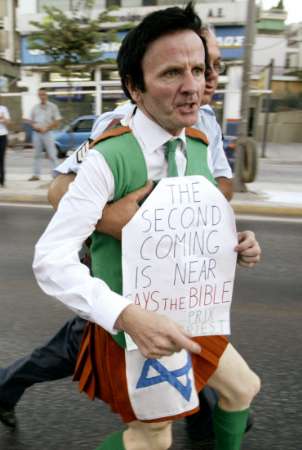 Oh, wait, there was something. There was one incident. But he was not Muslim. He was not a terrorist. He was a defrocked priest from Scotland wearing a man dress. He ran out in his little kilt and pushed the leader of the men’s marathon off of the road. Along with the kilt he had a sign on his back that read, "“The second coming is near says the Bible. The Grand Prix Priest Israel Fulfillment of Prophecy Says the Bible”." I am so sick of signs like his. Apparently a couple of years ago he ran out into the track of British Grand Prix traffic with cars traveling at 200 mph wearing a sign that read, "“Read the Bible -- the Bible is always right."” But he isn’t the only one toting a sign.
I see signs on Church billboards warning of hell for sinners or guilting people who pass by into attending church.
I see people stomping around free clinics carrying signs that read “"Abortion is murder.” "
I see signs around the capitol building that read "“Fags go to hell.” "
Signs, signs, everywhere are signs. But where is the love? What ever happened to “Love your neighbor and pray for those who persecute you.” God, it pisses me off. When are we going to learn that the kingdom is more than a matter of talk, but of power and love.
Wednesday, August 25, 2004
Nationalism and Sport
This year the Olympics have returned to its roots by going back to where it all started – Athens, Greece. I thought this was a great idea, and could possibly lend itself to a lot of great moments. So I started watching, but I didn’t see the sort of events that defined the Olympics back in the day. I see badminton, table tennis, synchronized diving and swimming, 2 versions of volleyball, and shooting. But perhaps the most annoying “competition” (I hesitate to call it “sport”) is the trampoline. Apparently team, individual, and some crazy performance was not enough gymnastics—they had to add in a trampoline into the mix. And they wonder why the stadiums are empty. I don’t know, could it be because there are about 500 different competitions, most of which are contrived to appease a small group and very few of which are worth watching?
The whole thing reminds me that our world is wasting so much time on things that just don’t matter. More than that, we continue to set up these events that make nations compete for the right to be called the best nation in the world. And lo and behold, the USA continues to dominate and come out on top. And we think we have come so far.
The whole thing reminds me that our world is wasting so much time on things that just don’t matter. More than that, we continue to set up these events that make nations compete for the right to be called the best nation in the world. And lo and behold, the USA continues to dominate and come out on top. And we think we have come so far.
Monday, August 23, 2004
The Dark Night of the Soul
I spend a lot of time wondering why I don’t feel like doing “spiritual” stuff like praying, Bible reading, etc. Perhaps it is because I feel guilty that I haven’t been doing them, or that I don’t even know if they will do anything. Other times, my devotional life is merely an exercise of study, not truly changing my heart. And so I wonder, “What is keeping me from that vibrant relationship that was mentioned in the previous post? What makes me so lackluster?”
I found a couple of answers when reading The Dark Night of the Soul by John of the Cross. He states:
“They will beg God to take away their imperfections, but they do this only because they want to find inner peace and not for God’s sake…Such souls become weary with spiritual exercises because they do not yield any consolation, and thus, they abandon them.”
Those comments hit me square in the face. I spend so much time thinking that I need to engage in these exercises so that I will feel right about myself and my relationship with God. But the truth is, that selfish attitude denies their power and ignores the purpose for the sacrifice of Christ. Christ died for God’s sake, to appease the holiness of God. As a result, the sacraments and my devotional life should not be focused on my feelings, but on the “invisible and unfelt grace of God [which] is much greater, and it is beyond our comprehension.”
In the end, it seems that my lackluster attitude and feelings are a failing on my part of being too selfish and self-absorbed. My focus should be on God, not on me. If my Bible Reading doesn’t seem to yield fruit, I must remember that I am studying the very word of God. If my prayers seem empty, I can’t forget that I am speaking directly to the God of the universe. And if my worship is lifeless at times, I am still praising the God of creation.
I’ll end with another quote from the Ragamuffin Gospel:
“In the final analysis, the real challenge of Christian growth is the challenge of personal responsibility. The Spirit of Jesus calls out a second time: Are you going to take charge of your life today? Are you going to be responsible for what you do? Are you going to believe?”
Friday, August 20, 2004
The Impetus
The title of my blog is taken from a chapter found in The Ragamuffin Gospel by Brennan Manning. I just finished reading it, and the chapter entitled “The Second Call” had a profound impact on me. Check out what Manning says:
“This is what the second call of Jesus Christ means today: A summons to a new and more radical leap in hope, to an existential commitment to the Good News of the wedding feast. If we believe the exciting message of Jesus, if we hope in vindication, we must love, and even more, we must run the risk of being loved…The call asks, do you really accept the message that God is head over heals in love with you? If in our hearts we really don’t believe that God loves us as we are, if we are still tainted by the lie that we can do something to make God love us more, we are rejecting the message of the cross.”
I appreciated these words because I come from a somewhat legalistic background that places a high priority on works, and leaves little room for experience. As a result, much of my Christian walk feels like it has been lifeless and devoid of passion. Notice some of the words that Manning uses: “radical leap, existential, exciting, risk, head over heals in love.” Those are the sorts of words that I want to use to describe my faith. I am tired of going through the motions of prayer, praise, confession, etc. I want to find in myself that place that Thomas Kelly describes in his work, A Testament of Devotion:
“Deep within us all there is an amazing inner sanctuary of the soul, a holy place, a Divine Center, a speaking Voice, to which we may continuously return. Eternity is at our hearts, pressing upon our time-torn lives, warming us with intimations of an astounding destiny, calling us home unto Itself. It is a light which illumines the face of God and casts new shadows and new glories upon our faces.”
To be an effective minister I believe that I need a place of security that I can that run too when confronted with apathy, disinterest, resistance to the Spirit, and all the other influences that come from congregations and that I place on myself. This fortress of solitude cannot be built overnight, and will require constant upkeep. But without it, I fear I will become another statistic in the Barna Research of those out of the ministry.
I will deal more with how this inner fortress is built in the next post, and probably throughout the rest of the blog. Any insight along the way will be greatly appreciated.Wednesday, August 18, 2004
The New Addition
Well, we just got home with Elijah. He is pretty awesome. He has it pretty well too. Eating, sleeping, some more eating. Not too bad.
Carrie did so well and there were no complications that I was not worried. During the delivery I didn't pass out or throw up. I just enjoyed it all.
I haven't really had time to digest it all. But when I do i will post something. For now, I am just soaking it all in.
Carrie did so well and there were no complications that I was not worried. During the delivery I didn't pass out or throw up. I just enjoyed it all.
I haven't really had time to digest it all. But when I do i will post something. For now, I am just soaking it all in.
Tuesday, August 17, 2004
A Little Background
As I state in the description, "This blog is dedicated to all those long time Christians who are still searching as well as to those newcomers who are just beginning the journey. May we learn together as we accept God’s call to renewed faith."
Subscribe to:
Posts (Atom)