I am working on a couple of things to post about, but it has been slow going. In lue of any original thought by me, I have another great prayer for you today. It is awesome and challanges the way we pray and approach God to be more specific and tangible. Hope you enjoy.
Reform our deformed lives
The words are familiar to us and we are filled with yearning. So we say them glibly, passionately, filled with hope — liberty, mercy, freedom, release, grace, peace. We have some fleeting notion of what we must have in order to live our lives fully. And we have some wistful certitude that these gifts are given only by you, you with the many names ... you ... holy, merciful, just, long-suffering, forgiving, demanding, promising. We gather ourselves together to subsume our hopes under your rich names.
We name you by your name, harbinger of liberty: hear our prayers for liberty. We are mindful of those caught, trapped, held, imprisoned by systems of enslavement and abuse, by ideas and ideologies that demean and immobilize, by unreal hopes and ungrounded fears. We ourselves know much of un-liberty, too wounded, too obedient, too driven, too fearful. Be our massive way of emancipation and let us all be "free at last."
We name you by your name, power of peace: hear our prayers for peace. We dare ask for the middle wall of hostility to be broken down, between liberals and conservatives in the church, between haves and have-nots, between victims and perpetrators, between all sorts of colleagues in this place, and in all those arenas besot with violence, rage, and hate. We know we are not meant for abusiveness, but we stutter before our vocation as peacemakers. Transform us beyond our fearfulness, our timidity, our excessive certitude, that we may be vulnerable enough to be peacemakers, and so to be called your very own children.
We name you by your name, fountain of mercy: hear our prayer for mercy. Our world grows weary of the battering and the vicious cycles that devour us. We seem to have no capacity to break those vicious cycles of anti-neighborliness and self-hate. We turn, like our people always have, to you, single source of newness. Waiting father, in your mercy receive us and all our weary neighbors. Remembering mother, hold us and all our desperate friends. Passionate lover, in your mercy cherish all our enemies. Gift giver, in your mercy embrace all those who are strangers to us, who are your well-beloved children. Make us, altogether, new.
Hear our prayers for liberty, for peace, for mercy. Form us in freedom and wholeness and gentleness. Reform our deformed lives toward obedience which is our only freedom, praise which is our only poetry, and love which is our only option. Our confidence matches our need, so we pray to you. Amen.
Monday, April 04, 2005

Friday, April 01, 2005
Easter Us
I really enjoy reading other people's prayers, especially theologians that I respect. It changes the often stale study of God into something alive and amazing. The depth and richness of these prayers is founded in the honest and creative images of God. It makes me think of God, and as a result, pray with more vitality and less rigidity.
Below is a prayer from Walter Brueggemann called "Easter us." And though it is appropriate for Easter SUnday, if we proclaim CHrist's death and resurrection daily, then I believe it is just as appropriate every day. Hope you enjoy it as much as I did.
Easter us
You God who terrified the waters,
who crashed your thunder,
who shook the earth, and
scared the wits out of chaos.
You God who with strong arm saved your people
by miracle and wonder and majestic act.
You are the same God to whom we turn,
we turn in our days of trouble,
and in our weary nights;
we look for steadfast love and are dismayed,
we wait for your promises, but wait in fatigue,
we ponder your forgetfulness and lack of compassion,
and we grow silent.
Our lives, addressed to you,
have this bitter-sweet taste of
loud-clashing miracles and weak-kneed doubt.
So we come in our bewilderment and wonderment,
deeply trusting, almost afraid to trust much,
passionately insisting, too timid to insist much,
fervently hoping, exhausted for hoping too much.
Look upon us in our deep need,
mark the wounds of our brothers and sisters just here,
notice the turmoil in our lives, and the lives of our families,
credit the incongruity of the rich and the poor in our very city,
and the staggering injustices abroad in our land,
tend to the rage out of control, rage justified by displacement,
rage gone crazy by absence, silence, and deprivation,
measure the suffering,
count the sufferers,
number the wounds.
You tamer of chaos and mender of all tears in the canvas of creation,
we ponder your suffering,
your crown of thorns,
your garment taken in lottery,
your mocked life,
and now we throw upon your suffering humiliation,
the suffering of the world.
You defeater of death, whose power could not hold you,
come in your Easter,
come in your sweeping victory,
come in your glorious new life.
Easter us,
salve wounds,
break injustice,
bring peace,
guarantee neighbor,
Easter us in joy and strength.
Be our God, be your true self, lord of life,
massively turn our life toward your life
and away from our anti-neighbor, anti-self deathliness.
Hear our thankful, grateful, unashamed Hallelujah!
Amen.
Walter Brueggemann, March 29, 1994
Below is a prayer from Walter Brueggemann called "Easter us." And though it is appropriate for Easter SUnday, if we proclaim CHrist's death and resurrection daily, then I believe it is just as appropriate every day. Hope you enjoy it as much as I did.
Easter us
You God who terrified the waters,
who crashed your thunder,
who shook the earth, and
scared the wits out of chaos.
You God who with strong arm saved your people
by miracle and wonder and majestic act.
You are the same God to whom we turn,
we turn in our days of trouble,
and in our weary nights;
we look for steadfast love and are dismayed,
we wait for your promises, but wait in fatigue,
we ponder your forgetfulness and lack of compassion,
and we grow silent.
Our lives, addressed to you,
have this bitter-sweet taste of
loud-clashing miracles and weak-kneed doubt.
So we come in our bewilderment and wonderment,
deeply trusting, almost afraid to trust much,
passionately insisting, too timid to insist much,
fervently hoping, exhausted for hoping too much.
Look upon us in our deep need,
mark the wounds of our brothers and sisters just here,
notice the turmoil in our lives, and the lives of our families,
credit the incongruity of the rich and the poor in our very city,
and the staggering injustices abroad in our land,
tend to the rage out of control, rage justified by displacement,
rage gone crazy by absence, silence, and deprivation,
measure the suffering,
count the sufferers,
number the wounds.
You tamer of chaos and mender of all tears in the canvas of creation,
we ponder your suffering,
your crown of thorns,
your garment taken in lottery,
your mocked life,
and now we throw upon your suffering humiliation,
the suffering of the world.
You defeater of death, whose power could not hold you,
come in your Easter,
come in your sweeping victory,
come in your glorious new life.
Easter us,
salve wounds,
break injustice,
bring peace,
guarantee neighbor,
Easter us in joy and strength.
Be our God, be your true self, lord of life,
massively turn our life toward your life
and away from our anti-neighbor, anti-self deathliness.
Hear our thankful, grateful, unashamed Hallelujah!
Amen.
Walter Brueggemann, March 29, 1994
Thursday, March 31, 2005
The Sum

I began a new series this week in youth group called “Greater than.” I will be exploring various spiritual concepts that are greater than we are used to, have experienced or even expected. This is the first.
Have you ever heard the saying, “The sum is greater than the individual parts”? I saw this concept clearly portrayed during the Olympics. We sent the best individual players to represent the US. This included with basketball. We sent the pros from the NBA. Most of these players average over 20 points a game and are recognized as the best players in the world. But we didn’t win the gold medal. Though our team was made up of the best individual players, our team was awful. They did not play well together. Instead, a team of less talented players who worked well together won. The point is simple: though individually a team should be better, if they don’t work together they will not succeed. The sum is greater than the individual parts.
The Bible contains the same sort of idea: “The body is a unit, though it is made up of many parts; and though all its parts are many, they form one body. So it is with Christ…But God has combined the members of the body and has given greater honor to the parts that lacked it, so that there should be no division in the body, but that its parts should have equal concern for each other. If one part suffers, every part suffers with it; if one part is honored, every part rejoices with it.” (1 Corinthians 12, 24b-26)
We are called “The body of Christ.” In other words, we as individuals, when put together, make up a body that Christ uses. We only function correctly when we work together. We only live as the body of Christ when we see each other as having worth and importance. We don’t all bring the same thing to the body. But we all have something and are also called to actually bring that something. Then, we are called to respect one another for what we do bring.
If you miss connecting to the body of Christ, you miss Christ. There is no healthy relationship with Jesus without a relationship to the church. Church is not just coming, singing a few songs, hearing some guy talk, and then heading home. Church is about friends. It is about fellowship. It is about glorifying God together. And it is about giving of ourselves to the body. It is not necessarily about what we get out of it either. Now understand, if you decide that you want to skip church you will be okay. Notice, YOU will be okay. But you are forgetting that about what you bring to other people. When you commit to coming to the body, you are not just committing your time for a certain period, you are committing yourself to other people. You showing up clearly says that you care about the rest of the body.
Much can be done for God’s kingdom and for one another when we commit to each other and work together without concern for what is wrong with each other. You may not be beautiful by the world’s standards. You may not be smart. You may not be flashy. But you are important. And alone none of us is as effective or as good as we are together. The sum is greater than the individual parts.
Tuesday, March 29, 2005
All Backwards

I grew up in the era when I would go to youth conferences and various speakers would decry rock music, saying that it is of Satan, and then having the audacity to also say that if you play the songs backwards you will find a hidden, Satanic message. I had 2 questions at the time that have never been answered
“Who had the idea to play a song backwards?”
“Who actually undertook this ‘ministry’ to play the songs backwards and decipher the lyrics?”
Well, regardless, I never bought into that sort of drivel in high school, being able to detect propaganda and grandstanding when I heard it. But I guess I was just too immature to realize the truth of their words. Now, for the first time I am a believer. The internet has changed my life. A guy has done the legwork and cleared up the blurry edges. The technology has caught up with the idea and we have irrefutable proof that all these songs that we thought were so benign are actually breeding scores of Satan worshippers across the world.
So make sure your families are only listening to CCM, because God forbid they get brainwashed.
PS - For those who don't know me this post is written "tongue in cheek"
Monday, March 28, 2005
Ripped from the Bible
 I don’t know if you have heard or not, but it is coming. What you ask? A terrible destructive force of Biblical proportion. Literally. It is as if someone stole the story line right from Exodus. I spent all weekened having my basketball watching interrupted with stupid teasers for a movie about (drum roll please)…LOCUSTS! “If you hear the buzz, it’s already too late!” Give me a break. USA spent last weekend showing all the worst of the natural disaster movies. Decent actors and actresses somehow get signed on to these awful movies, but that doesn’t help terrible, predictable storylines that include some of the stupidest human behavior I have ever seen.
 All this is to say, I don’t know why people have such an interest in these movies, and I don’t know why the writers and producers think that they can make me or any other viewer afraid of a locust. I mean seriously, if they are coming, how about some insecticide? A couple of planes flying over with some spray and the problem is solved. And even if it wasn’t, I don’t see how a grasshopper is getting into my house (even my house which has more holes in it than The DaVinci Code.
Unless (switch to dream mode), the locusts were of biblical proportion, but not from Exodus. What if they were the locusts from Revelation 9:
“And out of the smoke locusts came down upon the earth and were given power like that of scorpions of the earth. They were told not to harm the grass of the earth or any plant or tree, but only those people who did not have the seal of God on their foreheads. They were not given power to kill them, but only to torture them for five months. And the agony they suffered was like that of the sting of a scorpion when it strikes a man. During those days men will seek death, but will not find it; they will long to die, but death will elude them.
The locusts looked like horses prepared for battle. On their heads they wore something like crowns of gold, and their faces resembled human faces. Their hair was like women’s hair, and their teeth were like lions’ teeth. They had breastplates like breastplates of iron, and the sound of their wings was like the thundering of many horses and chariots rushing into battle. They had tails and stings like scorpions, and in their tails they had power to torment people for five months. They had as king over them the angel of the Abyss, whose name in Hebrew is Abaddon, and in Greek, Apollyon.”
Now that’s what I’m talking about. If it is so bad that people would rather die than deal with these scorpions, then you have a problem. Give me locusts that are genetically altered to be like the Revelation locusts, and I will watch. Until then, GET A REAL STORYLINE!!!
Wednesday, March 23, 2005
Setting the Stage
What do you need in order to enjoy God? What is it that you cannot do without when it comes to spending time in God’s presence?
Let me give you an example from the secular realm. People will say that they need weed to enjoy a conversation, need a Big screen TV with a killer sound system to enjoy sports and movies, or need certain kinds of toys to enjoy life.
These sorts of things that entice us turn into crutches that may in fact just take away from the simpler pleasure that exists. And perhaps this cultural phenomenon of incorporating all the extras to really enjoy something is making its way into our spiritual lives. So I repeat, “What do you need in order to enjoy God?”
I think of many things for myself. I need music many times. And not just any kind of music. I need:
well played music
in a style that I like most
with words that mean something.
I need revelation. To read the Bible just for the pleasure of encountering God is lost on me. I need something from it. Something insightful (perhaps to post on a blog). Something life changing. Something clever.
I need retreat. I have to get away to find God as if he cannot be found in all the noise of the world. It is too easy an excuse.
The more concentrate on “setting the stage” to encounter God, the more we are likely to miss him or become dependant on that singular experience. And in the end, God is replaced by our needs.
“Be still, and know that I am God;
I will be exalted among the nations,
I will be exalted in the earth.
The LORD Almighty is with us;
the God of Jacob is our fortress.”
Psalm 46:10-11
Let me give you an example from the secular realm. People will say that they need weed to enjoy a conversation, need a Big screen TV with a killer sound system to enjoy sports and movies, or need certain kinds of toys to enjoy life.
These sorts of things that entice us turn into crutches that may in fact just take away from the simpler pleasure that exists. And perhaps this cultural phenomenon of incorporating all the extras to really enjoy something is making its way into our spiritual lives. So I repeat, “What do you need in order to enjoy God?”
I think of many things for myself. I need music many times. And not just any kind of music. I need:
well played music
in a style that I like most
with words that mean something.
I need revelation. To read the Bible just for the pleasure of encountering God is lost on me. I need something from it. Something insightful (perhaps to post on a blog). Something life changing. Something clever.
I need retreat. I have to get away to find God as if he cannot be found in all the noise of the world. It is too easy an excuse.
The more concentrate on “setting the stage” to encounter God, the more we are likely to miss him or become dependant on that singular experience. And in the end, God is replaced by our needs.
“Be still, and know that I am God;
I will be exalted among the nations,
I will be exalted in the earth.
The LORD Almighty is with us;
the God of Jacob is our fortress.”
Psalm 46:10-11
Tuesday, March 22, 2005
World Water Day
Today is World Water Day. On this day, “States were invited to devote the Day, as appropriate in the national context, to concrete activities such as the promotion of public awareness through the publication and diffusion of documentaries and the organization of conferences, round tables, seminars and expositions related to the conservation and
development of water resources.” Sounds like a lot of meetings talking about what is wrong without any action. Sounds like the majority of the board meetings I attend.
Despite my cynicism of the implementation of World Water Day, I think this is a great thing to shoot for, but beyond the scope of our experience here in the US. We don’t know what it is like to be without running water, or even an abundance of water. After all we have the largest amount of fresh water in the Great Lakes. We have technology that can send water anywhere at any time. We don’t know what it is like to bathe in the same body of water as the cattle, or to have to boil our water to avoid impurities. We don’t know what it is like to have to walk 5 miles every day to the nearest clean water holding tank. So I applaud and salute the efforts of this day and the impetus behind it.
But it got me to thinking. I hear about environmental things like this regularly, but I never hear how they are actually observed. Does anyone plant a tree on Arbor Day? I don’t. Does anyone still recycle? I do somewhat. Does anyone know how much waste is produced daily? It is a bunch.
All this is to say, we have failed God and His creation. It is our responsibility to each other and to God to help the environment flourish. I am by no means a tree hugger, but I don’t think everything should disposable either. It is a travesty to see how much we waste. But what is the solution? We are shackled by our own culture that cares little for helping situations, but they are ready to piss and moan when gas prices skyrocket and now it takes $50 to fill up their gas guzzling SUV. Most people only care about the environment when it affects their bottom line, i.e. their pocket book.
Our concern for the world around us goes beyond our selfish enjoyment of it, but goes back a divine mandate to care for it. Any ideas on how we can actually accomplish such a lofty goal would be appreciated.
development of water resources.” Sounds like a lot of meetings talking about what is wrong without any action. Sounds like the majority of the board meetings I attend.
Despite my cynicism of the implementation of World Water Day, I think this is a great thing to shoot for, but beyond the scope of our experience here in the US. We don’t know what it is like to be without running water, or even an abundance of water. After all we have the largest amount of fresh water in the Great Lakes. We have technology that can send water anywhere at any time. We don’t know what it is like to bathe in the same body of water as the cattle, or to have to boil our water to avoid impurities. We don’t know what it is like to have to walk 5 miles every day to the nearest clean water holding tank. So I applaud and salute the efforts of this day and the impetus behind it.
But it got me to thinking. I hear about environmental things like this regularly, but I never hear how they are actually observed. Does anyone plant a tree on Arbor Day? I don’t. Does anyone still recycle? I do somewhat. Does anyone know how much waste is produced daily? It is a bunch.
All this is to say, we have failed God and His creation. It is our responsibility to each other and to God to help the environment flourish. I am by no means a tree hugger, but I don’t think everything should disposable either. It is a travesty to see how much we waste. But what is the solution? We are shackled by our own culture that cares little for helping situations, but they are ready to piss and moan when gas prices skyrocket and now it takes $50 to fill up their gas guzzling SUV. Most people only care about the environment when it affects their bottom line, i.e. their pocket book.
Our concern for the world around us goes beyond our selfish enjoyment of it, but goes back a divine mandate to care for it. Any ideas on how we can actually accomplish such a lofty goal would be appreciated.
Monday, March 21, 2005
Cold Season
Elijah got far worse before he got better. He refused to nurse, only taking his sippie cup. Then he would vomit up much of that. He would not be consoled, preferring instead to constantly whimper, occasionally bursting into cries. He would cough and sneeze, shooting snot and phlegm all over his face. Then trying to clean him up would only produce more wailing. His eyes were puffy and red; dark circles surrounded them. The only word to describe his state was “pitiful.” Yes, all who saw him were moved to pity for this little, helpless, unenviable baby.
But that was yesterday. Today is a different day. Today marks a new beginning. With the help of a lot of love, tenderness, and patience, Elijah is making a recovery and is back to being his jolly, robust self. He has endured his first cold and has won!
I can’t help but see this experience as a metaphor for God’s saving actions in the world. We wonder why anyone would love us, seemingly so unlovable. We look nasty; we act cruelly; we have few if any redeeming qualities. And yet When God looks at us, he is moved to pity for His children. He can’t help but love us despite our flaws and inadequacies. He can’t help but save us despite our helpless state. And though there is a sinful virus out there that inflicts hurt upon us, making us less than we really are, God is there helping us through it and bringing us out of it stronger, more grateful people.
Perhaps the metaphor is cheesy and a bit stretched, but that is what I have dealt with all weekend.
But that was yesterday. Today is a different day. Today marks a new beginning. With the help of a lot of love, tenderness, and patience, Elijah is making a recovery and is back to being his jolly, robust self. He has endured his first cold and has won!
I can’t help but see this experience as a metaphor for God’s saving actions in the world. We wonder why anyone would love us, seemingly so unlovable. We look nasty; we act cruelly; we have few if any redeeming qualities. And yet When God looks at us, he is moved to pity for His children. He can’t help but love us despite our flaws and inadequacies. He can’t help but save us despite our helpless state. And though there is a sinful virus out there that inflicts hurt upon us, making us less than we really are, God is there helping us through it and bringing us out of it stronger, more grateful people.
Perhaps the metaphor is cheesy and a bit stretched, but that is what I have dealt with all weekend.
Friday, March 18, 2005
Not much today. I am tired. Elijah has been irritable. Perhaps teeth. Perhaps an ear infection. We will see.
Plus, I spent the majority of yesterday watching basketball, and I have to say—pretty disappointed. I hope today has better games. The drama was not there. None of the games came down to the wire except West Virginia v Creighton. And since that one ended after midnight, I could only enjoy the replay on ESPN. So, here’s to hoping that today is a better day of basketball.
Of course, yesterday was not a complete wash. As per tradition, I had Corn Beef, Cabbage, and Potatoes for St. Patrick’s Day. Wonderful.
I’ll have something better on Monday. Have a great weekend.
Plus, I spent the majority of yesterday watching basketball, and I have to say—pretty disappointed. I hope today has better games. The drama was not there. None of the games came down to the wire except West Virginia v Creighton. And since that one ended after midnight, I could only enjoy the replay on ESPN. So, here’s to hoping that today is a better day of basketball.
Of course, yesterday was not a complete wash. As per tradition, I had Corn Beef, Cabbage, and Potatoes for St. Patrick’s Day. Wonderful.
I’ll have something better on Monday. Have a great weekend.
Thursday, March 17, 2005
Seder what?

I have finished reading the Torah (first 5 books of the Hebrew Bible) and coincidentally last night our church experienced a Seder meal together. For those who have never eaten a Seder meal, it is a stripped down Jewish Passover meal somewhat reinterpreted in a Christian light. It was interesting to hear the Passover story retold in light of having recently read the Biblical account and the resulting laws and instructions. Unfortunately, Elijah was getting tired, so I had to leave after the meal, before the last 2 cups, the Aficomen, etc.
One particular interpretation I enjoyed was that of the second cup. Jewish people do not drink from that cup, because it represents the plagues brought upon Egypt and sin. And in the garden, when Jesus prays for the cup to be taken from him, he speaks of this cup. He asks not to drink it, knowing full well what it contains and what will result. Fascinating stuff.
All this is to say, an appreciation for the history, culture, and practice of the Biblical Israelites makes the New Testament come alive. You see why Jesus did some of the things he did, and why the Israelites responded as they did. We see why some of Jesus’ words were so controversial, and why his actions at times angered the religious leaders. I would go as far as to say that I don’t think we can properly (or perhaps fully) understand and interpret the NT without first gaining a profound respect and understanding of the OT.
Until next time, Shalom (peace, wholeness, wellness)
Wednesday, March 16, 2005
If it weren't for DOOM
Deuteronomy 24:16
"Parents shall not be put to death for their children, nor children for their parents. Each person shall be put to death for his own sin."

It seems that it is all the rage to pass blame around. Take for example our court system. Let’s say that you kill somebody. Obviously, it is not your fault. You couldn’t have committed such a heinous crime on your own. No, there are other factors to blame. It is your parent’s fault for not showing you enough love. It is your body’s fault for having the improper chemical makeup causing you to act out in improper ways. It is the Hollywood’s fault for glorifying murder. It is the rapper's fault for singing about his gat. It is the video game maker’s fault for encouraging violence.
The list goes on and on, but it seems that a winning defense can be built around blaming others for your own actions. But the Bible, especially the Law Code in the Old Testament is clear—we are responsible for what we do. I am tired of people copping out and blaming everything else. I don’t deny that our environments contribute to our personalities, or that our experiences play a role in our future decisions. I sympathize with those who have had to experience abuse or have seen things that people never should. But notice the verbs I used—“contribute” and “play a role.”
In the end, regardless of where we have come from or what has happened to us we still make our own decisions and we must be held responsible and accountable for them. Otherwise, I would like to see defenses in murder cases put the parents on trial, or Hollywood, or whomever or whatever else they think has caused the crime. Just as that sort of defense would be ludicrous, so too is it ludicrous to blame others for what each of us do. It is time for people to buck up, and take some responsibility. Only when we take responsibility will we be able to fully accept God’s grace and forgiveness, which is the first step in the process of growing into better people.
"Parents shall not be put to death for their children, nor children for their parents. Each person shall be put to death for his own sin."
It seems that it is all the rage to pass blame around. Take for example our court system. Let’s say that you kill somebody. Obviously, it is not your fault. You couldn’t have committed such a heinous crime on your own. No, there are other factors to blame. It is your parent’s fault for not showing you enough love. It is your body’s fault for having the improper chemical makeup causing you to act out in improper ways. It is the Hollywood’s fault for glorifying murder. It is the rapper's fault for singing about his gat. It is the video game maker’s fault for encouraging violence.
The list goes on and on, but it seems that a winning defense can be built around blaming others for your own actions. But the Bible, especially the Law Code in the Old Testament is clear—we are responsible for what we do. I am tired of people copping out and blaming everything else. I don’t deny that our environments contribute to our personalities, or that our experiences play a role in our future decisions. I sympathize with those who have had to experience abuse or have seen things that people never should. But notice the verbs I used—“contribute” and “play a role.”
In the end, regardless of where we have come from or what has happened to us we still make our own decisions and we must be held responsible and accountable for them. Otherwise, I would like to see defenses in murder cases put the parents on trial, or Hollywood, or whomever or whatever else they think has caused the crime. Just as that sort of defense would be ludicrous, so too is it ludicrous to blame others for what each of us do. It is time for people to buck up, and take some responsibility. Only when we take responsibility will we be able to fully accept God’s grace and forgiveness, which is the first step in the process of growing into better people.
Tuesday, March 15, 2005
Don't Spurn an Edomite
Deuteronomy 23:7
”But don’t spurn an Edomite; he’s your kin.
And don’t spurn an Egyptian; you were a foreigner in his land.
Children born to Edomites and Egyptians may enter the congregation of GOD in the third generation.”
We live in a culture that encourages getting even, never letting anyone beat you, mock you, or look down upon you. With pithy statements like, “I don’t get mad, I get even,” we selfishly denigrate people with our justification of being previously wronged firmly in hand. And we even quote OT phrases like, “An eye for en eye” and think that somehow we are doing what is right. But God is not pleased. His desire is not for “justice”—at least not how we conceive of justice.
Imagine being an Israelite. There are many nations that have offended, wronged, and even hurt you. Let’s begin with Edom. They treat you like crap. They don’t help when they should. And they are even related to you (descendants of Esau). How can they call themselves brothers and sisters and act like that? It seems okay to treat family like dirt, especially if they aren’t going to act “properly.”
Then there are those vile Egyptians. You remember what they did to you and your ancestors. They took advantage of you. They enslaved you. Were it not for divine intervention they would have destroyed your life. Just thinking about them makes you want to lash out. Let’s hurt them and see how they like it!
But Yahweh picks out these two groups specifically and says, “Don’t burn with anger. Don’t repay evil for evil. Don’t spurn them. Instead, worship with them.” His reasons are not all that compelling. Bloodlines and occasional hospitality don’t make up for the years of hurt they have inflicted upon you.
But perhaps Yahweh has reasons beyond those. Perhaps Yahweh sees Himself in the way he wants you to treat them. Perhaps Yahweh wants to impart a little bit of the grace He possesses into your daily actions. Yes it is not easy to love those who have committed the first offense against you. But it is not easy to love you either.
”But don’t spurn an Edomite; he’s your kin.
And don’t spurn an Egyptian; you were a foreigner in his land.
Children born to Edomites and Egyptians may enter the congregation of GOD in the third generation.”
We live in a culture that encourages getting even, never letting anyone beat you, mock you, or look down upon you. With pithy statements like, “I don’t get mad, I get even,” we selfishly denigrate people with our justification of being previously wronged firmly in hand. And we even quote OT phrases like, “An eye for en eye” and think that somehow we are doing what is right. But God is not pleased. His desire is not for “justice”—at least not how we conceive of justice.
Imagine being an Israelite. There are many nations that have offended, wronged, and even hurt you. Let’s begin with Edom. They treat you like crap. They don’t help when they should. And they are even related to you (descendants of Esau). How can they call themselves brothers and sisters and act like that? It seems okay to treat family like dirt, especially if they aren’t going to act “properly.”
Then there are those vile Egyptians. You remember what they did to you and your ancestors. They took advantage of you. They enslaved you. Were it not for divine intervention they would have destroyed your life. Just thinking about them makes you want to lash out. Let’s hurt them and see how they like it!
But Yahweh picks out these two groups specifically and says, “Don’t burn with anger. Don’t repay evil for evil. Don’t spurn them. Instead, worship with them.” His reasons are not all that compelling. Bloodlines and occasional hospitality don’t make up for the years of hurt they have inflicted upon you.
But perhaps Yahweh has reasons beyond those. Perhaps Yahweh sees Himself in the way he wants you to treat them. Perhaps Yahweh wants to impart a little bit of the grace He possesses into your daily actions. Yes it is not easy to love those who have committed the first offense against you. But it is not easy to love you either.
Monday, March 14, 2005
A Community Challenge
I have been reading through Deuteronomy, and it strikes me that though we may often think that the laws are full of “do nots” that were instituted to keep the Israelites from impurity, there are also many other types of commands. We should keep in mind that the people were trying to form a society, not just a religion. As such, there are many interesting statements that are not prohibitions, but good guidelines for living in a community. From Deuteronomy 22:1-4; 23:24 in The Message Version:
“If you see your neighbor’s ox or sheep wandering away, don’t pretend not to see it. Take it back to its owner. If it does not belong to someone nearby or you don’t know who the owner is, keep it until the owner comes looking for it; then return it. Do the same if you find your neighbor’s donkey, clothing, or anything else your neighbor loses. Don’t pretend you did not see it. If you see your neighbor’s ox or donkey lying on the road, do not look the other way. Go and help your neighbor get it to its feet!”
“You may eat your fill of grapes from your neighbor’s vineyard, but do not take any away in a basket. And you may pluck a few heads of your neighbor’s grain by hand, but you may not harvest it with a sickle.”
Both this passages are simple, real life, applicable situations (in their context) that kindness and love could be shown.
If you see a stray animal, don’t just ignore it. Take some initiative and find out what can be done to rectify the situation.
If an animal is lying in the road, make sure it is not dead. Instead, see to it that the owner gets it moving again.
When you have a field, allow people walking by to sample to fruits. And those of you sampling, don’t take advantage. Enjoy one another’s good will.
The New Testament Church picks up this same concept when everyone shared everything, and cared about one another’s well being. A godly community is not defined simply by regulations and prohibitions. A godly community functions by extending love and kindness to one another. And until our churches can get past the 10 Commandments to the heart and soul of loving communities, we will continue to refrain from extending kindness, and the animals will continue to run wild.
“If you see your neighbor’s ox or sheep wandering away, don’t pretend not to see it. Take it back to its owner. If it does not belong to someone nearby or you don’t know who the owner is, keep it until the owner comes looking for it; then return it. Do the same if you find your neighbor’s donkey, clothing, or anything else your neighbor loses. Don’t pretend you did not see it. If you see your neighbor’s ox or donkey lying on the road, do not look the other way. Go and help your neighbor get it to its feet!”
“You may eat your fill of grapes from your neighbor’s vineyard, but do not take any away in a basket. And you may pluck a few heads of your neighbor’s grain by hand, but you may not harvest it with a sickle.”
Both this passages are simple, real life, applicable situations (in their context) that kindness and love could be shown.
If you see a stray animal, don’t just ignore it. Take some initiative and find out what can be done to rectify the situation.
If an animal is lying in the road, make sure it is not dead. Instead, see to it that the owner gets it moving again.
When you have a field, allow people walking by to sample to fruits. And those of you sampling, don’t take advantage. Enjoy one another’s good will.
The New Testament Church picks up this same concept when everyone shared everything, and cared about one another’s well being. A godly community is not defined simply by regulations and prohibitions. A godly community functions by extending love and kindness to one another. And until our churches can get past the 10 Commandments to the heart and soul of loving communities, we will continue to refrain from extending kindness, and the animals will continue to run wild.
Friday, March 11, 2005
A Good Cleaning
On Tuesday I posted about the bizarre language that we use in Christianity, and gave an example of how it can be twisted and manipulated for strange ends. I thought that might be the end of it. However, I have stumbled across a story from beliefnet.com that takes the cake. They call it “Mrs. Benny Hinn’s Moment of Zen”:
Televangelist Benny Hinn is threatening to sue the religious satire magazine The Door for the video clip it is distributing that shows Hinn's wife, Suzanne, preaching at their former church in Orlando, Florida. She says if you're a lifeless, blackslidden Christian, you need a "Holy Ghost enema... right up your rear end."
I have to say, nothing says “the Kingdom” like a Holy Ghost enema. Now, I am all for using metaphors and communicating the gospel in the vernacular of the day. But come on! Are you serious?
Well, until next time, keep your Jesus’ vampire blood on tap, and rectums immaculate.
By the way, the video of this gem is on that website as well.
Televangelist Benny Hinn is threatening to sue the religious satire magazine The Door for the video clip it is distributing that shows Hinn's wife, Suzanne, preaching at their former church in Orlando, Florida. She says if you're a lifeless, blackslidden Christian, you need a "Holy Ghost enema... right up your rear end."
I have to say, nothing says “the Kingdom” like a Holy Ghost enema. Now, I am all for using metaphors and communicating the gospel in the vernacular of the day. But come on! Are you serious?
Well, until next time, keep your Jesus’ vampire blood on tap, and rectums immaculate.
By the way, the video of this gem is on that website as well.
Thursday, March 10, 2005
Grow Up
There was once a show on NBC called “Ed.” It was pretty good show. But eventually the series ended. Well now they are replaying the series on TBS at 12:00 noon. So I occasionally take an episode in. The other day I was watching and was struck by the conversation between Ed and Carol. It was short, but went something like this:
Carol: Every 17-year-old kid wants to grow up and be a rock star. Most of them wise up and grow out of it.
Ed: Why are we always so condescending toward our younger selves? We should be looking back in awe of who we were. All that passion. All that fire. All those dreams. And then it all fades and people say, “That is just part of growing up.”
Now combine that with a short quote from Regan’s blog from the other day, courtesy of Doug Pagitt:
“We often say that we want the dreams of Solomon's Porch to reflect the dreams of the people in our community. We want that list to keep growing and changing with us. It was never meant to be stagnant.”
Perhaps the reason churches lose intensity or become stagnant and ineffective is because the dreamers stop dreaming. Or, perhaps their dreams have been squashed in light of practicality or tradition. When we hear phrases like, “It’s never been done that way before,” or “I don’t think the people are ready for that,” or “That sounds too hard,” it is like water tossed on the fire. It quenches the flames of excitement.
I appreciate the outlook of Solomon’s Porch where everyone’s dreams are important and they shape where that church goes. Granted, there are times when dreams and goals are unattainable, at least by human effort. I think that is why Jesus says things like, “The kingdom belongs to such as children.” Their innocence, enthusiasm, and joy are characteristics that mark the kingdom. They don’t know that something can’t be done. They just see the end result.
The passion of youth. It should mark the kingdom and all of our lives because we believe in a God that can do the impossible.
Carol: Every 17-year-old kid wants to grow up and be a rock star. Most of them wise up and grow out of it.
Ed: Why are we always so condescending toward our younger selves? We should be looking back in awe of who we were. All that passion. All that fire. All those dreams. And then it all fades and people say, “That is just part of growing up.”
Now combine that with a short quote from Regan’s blog from the other day, courtesy of Doug Pagitt:
“We often say that we want the dreams of Solomon's Porch to reflect the dreams of the people in our community. We want that list to keep growing and changing with us. It was never meant to be stagnant.”
Perhaps the reason churches lose intensity or become stagnant and ineffective is because the dreamers stop dreaming. Or, perhaps their dreams have been squashed in light of practicality or tradition. When we hear phrases like, “It’s never been done that way before,” or “I don’t think the people are ready for that,” or “That sounds too hard,” it is like water tossed on the fire. It quenches the flames of excitement.
I appreciate the outlook of Solomon’s Porch where everyone’s dreams are important and they shape where that church goes. Granted, there are times when dreams and goals are unattainable, at least by human effort. I think that is why Jesus says things like, “The kingdom belongs to such as children.” Their innocence, enthusiasm, and joy are characteristics that mark the kingdom. They don’t know that something can’t be done. They just see the end result.
The passion of youth. It should mark the kingdom and all of our lives because we believe in a God that can do the impossible.
Tuesday, March 08, 2005
Be afraid. Be very afraid.
So, I occasionally search Google for pictures to use in the Sunday Service at church. I put in things like “Jesus,” “Cross,” etc. Once, I put in “Communion” and I found my way to the most bizarre thing I have seen in a while. I have reproduced it for you below. But you can find it in all its glory here. Now I know that the concept of Jesus’ body and blood is a little weird, but this is taking it a little far. Ugh. I get wierded out just thinking about it. Let me know if you think this sort of theology is good for reaching the Goth group or not.

Communion
Jesus is a vampire. Living in my veins.
His blood is my desire. Strike the nail and let it rain.
Father, feed your children. We hunger for the feast.
Flesh cut from your body. That saves us from the beast.
Pleasure from your pain. Your sacrifice, our gain.
Strike the nail and break the vein. Let it rain.
I have the fear of God. The wrath and retribution.
A terror that will never hide. And has no absolution.
I want to be like Jesus. A vampire in the flesh.
Spare the children of my coven. And sacrifice the rest.
Strike the nail. Break the vein.
Bleed on me. Let it rain.
Communion
Jesus is a vampire. Living in my veins.
His blood is my desire. Strike the nail and let it rain.
Father, feed your children. We hunger for the feast.
Flesh cut from your body. That saves us from the beast.
Pleasure from your pain. Your sacrifice, our gain.
Strike the nail and break the vein. Let it rain.
I have the fear of God. The wrath and retribution.
A terror that will never hide. And has no absolution.
I want to be like Jesus. A vampire in the flesh.
Spare the children of my coven. And sacrifice the rest.
Strike the nail. Break the vein.
Bleed on me. Let it rain.
Monday, March 07, 2005
The Kingdom Come
I complain a lot about what the church is doing wrong, and the things that I wished they would do more of. But today, I want to share a great thing that has happened in the church that I serve. A need came up in our congregation, and we pulled together and rectified the situation.

A low to no income family live in a house that had a tin roof that was not doing the job of keeping the weather out. The rain would come in and was ruining parts of the house. They don’t have much money to fix the problem, so they just lived with it. One of our members noticed the situation and brought it to the church for help. We tried some government organizations, but the amount of red tape and the time it would take made it not worth the effort. So we just brought it to the congregation and asked for donations of money and time. The response was awesome. We raised the money for a new metal roof, and the men of the church put it on the house this weekend. I have a picture of the new house here. If you would like to see more you can see them on my website.
If only this church and other churches would focus on loving the poor among us, the backbiting and disputes that often crop up would fall by the wayside. When we are united in a common goal, those other things seem so futile and not even worth the effort.
More than that, people who only have a passing concern in attending church services came out en mass to help. It proves that to me that people don’t get involved with the church not because they aren’t good people, but because they are passionate about things other than hearing another lesson.
I hope that our church can continue to be unified, not just when projects like this come up, but in all things as we seek to glorify God together.

A low to no income family live in a house that had a tin roof that was not doing the job of keeping the weather out. The rain would come in and was ruining parts of the house. They don’t have much money to fix the problem, so they just lived with it. One of our members noticed the situation and brought it to the church for help. We tried some government organizations, but the amount of red tape and the time it would take made it not worth the effort. So we just brought it to the congregation and asked for donations of money and time. The response was awesome. We raised the money for a new metal roof, and the men of the church put it on the house this weekend. I have a picture of the new house here. If you would like to see more you can see them on my website.
If only this church and other churches would focus on loving the poor among us, the backbiting and disputes that often crop up would fall by the wayside. When we are united in a common goal, those other things seem so futile and not even worth the effort.
More than that, people who only have a passing concern in attending church services came out en mass to help. It proves that to me that people don’t get involved with the church not because they aren’t good people, but because they are passionate about things other than hearing another lesson.
I hope that our church can continue to be unified, not just when projects like this come up, but in all things as we seek to glorify God together.
Friday, March 04, 2005
The Dream is Over
 A few weeks ago I got an email from my brother with a proposition. At first I was startled he actually made contact. Once I got over that shock, I was then startled by the nature of the communication. He wanted to round up the family and audition for the next installment of “The Amazing Race.” Instead of 2 people, it would be 4—all from a family. He had in mind himself, my sister, my father, and me.
 I have wanted to go on The Amazing Race since I saw my first episode, so I immediately agreed. I mean, traveling across the world to these amazing places in a competition is my idea of a good time. But, we couldn’t quite get our stuff together, and even if we could, “adult responsibilities” would really hinder being gone for a month, assuming that we would have gone all the way. So, we will not be entering.
But I would have really enjoyed that. Though my siblings and I have struggled at times to get along, we have made great strides in the last few years. I would like to think that it would be a well-oiled machine with good ideas and participation from everyone. With my ex-FBI agent dad running the show and the competitive nature of the siblings pushing us forward, we would be a force to contend with. Sure, there might be some conflict, but nothing that we couldn’t resolve. The audience would also be privy to some quality sarcasm I would think.
But it will not be. Maybe next time. If you hear of another family themed reality show, let me know.
Thursday, March 03, 2005
Unity Sermon Part 3
Just as our relationship with God is restored, our relationship with one another is restored. The second type of unity resulting from the cross centers around who we are and impacts our relationships with each other: “But God chose the foolish things of the world to shame the wise; God chose the weak things of the world to shame the strong. He chose the lowly things of this world and the despised things—and the things that are not—to nullify the things that are, so that no one may boast before him.”
There is a new show on MTV called “My Super Sweet 16.” I can’t watch it for very long because I get so upset. It makes me want to punch something, usually a person. So I have to turn it off to avoid committing assault. Let me tell you why I get so enraged. Basically, the show follows around rich spoiled kids in the weeks leading up to their 16th birthday and portrays all the drama that goes with their birthdays. All of these kids throw these huge parties, I mean bigger than most proms and many weddings. These parties are complete with formal outfits, nice clubs and food, and over the top entertainment. Now, that in and of itself is too much in my opinion. No 16-year-old needs a party that costs $40,000. It is beyond a waste of money and time.
But that is not what gets my blood boiling. This show clearly portrays for all to see what is wrong with our society. These stuck up teenagers begin classifying everyone else. They form their own caste system. They of course are at the top. Under them are their friends that of course get to come to the party. Under them are the ones “privileged” enough to receive an invitation. Under them are those that are on the border that have to do something good enough to make it in. And of course under them are the ones who have no hope of getting an invitation—the losers, the uncool, the freshmen. And these kids go around taunting this bottom level group as though they are not even worth being alive. Just talking about it right now is getting me upset. I want to go throttle these kids and yell, “Who do you think you are? What makes you so special? All you have is a rich daddy!”
But the cross teaches an entirely different message. The standards of who is in and who is out were thrown out the window. The message of the cross is the equality and unity of all people. There is no successful and unsuccessful, rich and poor, best and worst, good and bad, cool and geek, popular and unpopular, healthy and cripple, strong and weak. We are all on level footing. There is no more racism, sexism, chauvinism, bigotry, hatred or envy. It is a new reality that God has chosen to implement. That is the gospel message. It should be great news to us! Amen? You see when we take such a notion seriously, it is not just words—it is power.
But such a message grates against our concepts of competition and fairness. It inverts the pyramid of success. We think that the best are at the top and blessed by God. The sinners are worthless, and at the bottom. After all I have worked hard to get where I am at. I have been good for so long. How dare you compare me with him. How dare you lump me into the same category as her. That was sure how the people in Jesus time looked at it. Jesus’ message of equality and unity enraged the leaders.
But take another look at the cross, because the cross showed everything that was wrong with the world. The Romans were threatened that their power was being infringed upon. The Jewish leaders were frightened that their hold over the people was slipping. The Jewish people were afraid that this Jesus would enrage the Romans and cause the ruin of their comfortable way of life. So these forces got together and took it out on this simple man from Galilee who talked of liberation for the oppressed, freedom for the slaves, healing for the sick, equality for the poor, and forgiveness for the sinners. They could not stand around while this crazy prophet upset the careful balance that existed. How dare he put everyone on level footing. But the only way to stop such a message was to kill the messenger. Killing him would put a stop to all this foolishness. But it did not put a stop to the message. Instead of ending it, they only pushed it forward. They ended up accomplishing the very thing they were trying to stop. Because the message is too powerful to be quenched.
Jesus message rang through loud and clear:
“Blessed are the physically repulsive, those who smell bad, the twisted, misshapen, deformed, the too big, too little, too loud, the bald, the fat, and the old.
Blessed are the drop-outs, the burn outs, the broken, and the divorced.
Blessed are the overemployed, the underemployed, the unemployed, the unemployable, the swindled, the shoved aside, and the replaced.
Blessed are the lonely, the incompetent, and the stupid.
Blessed are the emotionally starved or emotionally dead.
Why are they blessed?—because they are all riotously celebrated in the party of Jesus.”
My favorite show on TV is “Lost.” It is basically the story of 40 or so people whose plane that was traveling from Sydney, Australia to Los Angeles has crashed on an island. They are the only survivors from around 150 or so people traveling. And this band of survivors must figure out what they are going to do. Their hope of survival is slim to none. And so they must decide how they are going to live. This past week had some unbelievable theological themes. But the most important one was this—though their circumstance were dire, though their situation was bleak, though they had lost all their possessions and everything they were familiar with, and though they seemed to have no hope, in the midst of all that, they had something that most of the world would never have. They had a fresh start. One of the characters said it plainly, "On this island, everone gets a new start." They could start over. No matter who they were in their previous life. No matter what role the world forced them to play. No matter what people told them that they could or could not do. No matter how many times they had been beaten down, ignored, or mocked. No matter what they had done in the past, they got a new chance to be the people they always wanted to be.
That is the definition and picture of redemption. And that is the picture of the cross. Christ’s sacrifice on the cross brought unity between us and God. Once sinners, we are saved. Once forced to compare ourselves with everyone else, we are equal. We are unified. Though we were once enemies with God and with one another, we are now friends. Unity comes from the salvation of the cross.
Take another look at the disciples. The disciples could not understand why they were suffering. This was not what they signed up for. This was not the way it was to work out. Jesus was supposed to be victorious, not end up dead. But once they could see past the failure, once they saw his victory over the powers, they saw the hope. They saw that the teachings of Christ were true, that the old way of doing things was done. That a new age was here. So they came together and lived out the message the Christ had given to them. They continued to live out the message that was such good news to the outcasts.
And their message is our message. Maybe you found yourself in one of those scenes I described at the beginning. Perhaps you have doubted your worth in life. After all, everywhere we look we are told that if we do not have a perfect figure to go with a perfect appearance, if we are not the best looking, if we are not the most successful, if we are not the smartest, than we are worthless. But God has spoken loudly and clearly on the cross: “Those things don’t matter. Those things don’t matter.” Accepting His forgiveness is what matters. Living the life of acceptance and unity is what matters. God is calling us today to be reconciled to Him and to one another. It’s a whole new ballgame. And if you have never really believed that God accepts you for who you are, it is time to give all of that over to Him. He wants to take it away, and make you a new person.
There is a new show on MTV called “My Super Sweet 16.” I can’t watch it for very long because I get so upset. It makes me want to punch something, usually a person. So I have to turn it off to avoid committing assault. Let me tell you why I get so enraged. Basically, the show follows around rich spoiled kids in the weeks leading up to their 16th birthday and portrays all the drama that goes with their birthdays. All of these kids throw these huge parties, I mean bigger than most proms and many weddings. These parties are complete with formal outfits, nice clubs and food, and over the top entertainment. Now, that in and of itself is too much in my opinion. No 16-year-old needs a party that costs $40,000. It is beyond a waste of money and time.
But that is not what gets my blood boiling. This show clearly portrays for all to see what is wrong with our society. These stuck up teenagers begin classifying everyone else. They form their own caste system. They of course are at the top. Under them are their friends that of course get to come to the party. Under them are the ones “privileged” enough to receive an invitation. Under them are those that are on the border that have to do something good enough to make it in. And of course under them are the ones who have no hope of getting an invitation—the losers, the uncool, the freshmen. And these kids go around taunting this bottom level group as though they are not even worth being alive. Just talking about it right now is getting me upset. I want to go throttle these kids and yell, “Who do you think you are? What makes you so special? All you have is a rich daddy!”
But the cross teaches an entirely different message. The standards of who is in and who is out were thrown out the window. The message of the cross is the equality and unity of all people. There is no successful and unsuccessful, rich and poor, best and worst, good and bad, cool and geek, popular and unpopular, healthy and cripple, strong and weak. We are all on level footing. There is no more racism, sexism, chauvinism, bigotry, hatred or envy. It is a new reality that God has chosen to implement. That is the gospel message. It should be great news to us! Amen? You see when we take such a notion seriously, it is not just words—it is power.
But such a message grates against our concepts of competition and fairness. It inverts the pyramid of success. We think that the best are at the top and blessed by God. The sinners are worthless, and at the bottom. After all I have worked hard to get where I am at. I have been good for so long. How dare you compare me with him. How dare you lump me into the same category as her. That was sure how the people in Jesus time looked at it. Jesus’ message of equality and unity enraged the leaders.
But take another look at the cross, because the cross showed everything that was wrong with the world. The Romans were threatened that their power was being infringed upon. The Jewish leaders were frightened that their hold over the people was slipping. The Jewish people were afraid that this Jesus would enrage the Romans and cause the ruin of their comfortable way of life. So these forces got together and took it out on this simple man from Galilee who talked of liberation for the oppressed, freedom for the slaves, healing for the sick, equality for the poor, and forgiveness for the sinners. They could not stand around while this crazy prophet upset the careful balance that existed. How dare he put everyone on level footing. But the only way to stop such a message was to kill the messenger. Killing him would put a stop to all this foolishness. But it did not put a stop to the message. Instead of ending it, they only pushed it forward. They ended up accomplishing the very thing they were trying to stop. Because the message is too powerful to be quenched.
Jesus message rang through loud and clear:
“Blessed are the physically repulsive, those who smell bad, the twisted, misshapen, deformed, the too big, too little, too loud, the bald, the fat, and the old.
Blessed are the drop-outs, the burn outs, the broken, and the divorced.
Blessed are the overemployed, the underemployed, the unemployed, the unemployable, the swindled, the shoved aside, and the replaced.
Blessed are the lonely, the incompetent, and the stupid.
Blessed are the emotionally starved or emotionally dead.
Why are they blessed?—because they are all riotously celebrated in the party of Jesus.”
My favorite show on TV is “Lost.” It is basically the story of 40 or so people whose plane that was traveling from Sydney, Australia to Los Angeles has crashed on an island. They are the only survivors from around 150 or so people traveling. And this band of survivors must figure out what they are going to do. Their hope of survival is slim to none. And so they must decide how they are going to live. This past week had some unbelievable theological themes. But the most important one was this—though their circumstance were dire, though their situation was bleak, though they had lost all their possessions and everything they were familiar with, and though they seemed to have no hope, in the midst of all that, they had something that most of the world would never have. They had a fresh start. One of the characters said it plainly, "On this island, everone gets a new start." They could start over. No matter who they were in their previous life. No matter what role the world forced them to play. No matter what people told them that they could or could not do. No matter how many times they had been beaten down, ignored, or mocked. No matter what they had done in the past, they got a new chance to be the people they always wanted to be.
That is the definition and picture of redemption. And that is the picture of the cross. Christ’s sacrifice on the cross brought unity between us and God. Once sinners, we are saved. Once forced to compare ourselves with everyone else, we are equal. We are unified. Though we were once enemies with God and with one another, we are now friends. Unity comes from the salvation of the cross.
Take another look at the disciples. The disciples could not understand why they were suffering. This was not what they signed up for. This was not the way it was to work out. Jesus was supposed to be victorious, not end up dead. But once they could see past the failure, once they saw his victory over the powers, they saw the hope. They saw that the teachings of Christ were true, that the old way of doing things was done. That a new age was here. So they came together and lived out the message the Christ had given to them. They continued to live out the message that was such good news to the outcasts.
And their message is our message. Maybe you found yourself in one of those scenes I described at the beginning. Perhaps you have doubted your worth in life. After all, everywhere we look we are told that if we do not have a perfect figure to go with a perfect appearance, if we are not the best looking, if we are not the most successful, if we are not the smartest, than we are worthless. But God has spoken loudly and clearly on the cross: “Those things don’t matter. Those things don’t matter.” Accepting His forgiveness is what matters. Living the life of acceptance and unity is what matters. God is calling us today to be reconciled to Him and to one another. It’s a whole new ballgame. And if you have never really believed that God accepts you for who you are, it is time to give all of that over to Him. He wants to take it away, and make you a new person.
Wednesday, March 02, 2005
Unity Sermon Part 2
When I look at the cross, I don’t see harmony. I see conflict. When I read the gospel accounts I don’t see a unified group of believers, I see chaos. At the time of Jesus’ crucifixion, followers of Jesus were down to a handful. Peter had denied him. The other disciples had gone underground. There was no unity. There was no expectation of salvation. Their hopes of a New Israel were little more than wasted dreams. It was over. The cross had destroyed everything.
But the story was not over. Acts 2 describes a group of people that were united in heart, mind, and purpose. It talks of thousands coming to believe in this crucified Jesus in one day. It describes perfect accord and amazing power among the believers. So what happened? What caused this transformation? How could this rag tag group of cast offs and never bes find unification? Why would thousands of people want to follow the teachings of some dead guy? Because the message of the cross spoke clearly. Christ’s sacrifice resulted in unity for all the world, and that was the message that brought them together, and changed their destinies. Because of the cross they were now a passionate group of believers, of one mind, one voice, and one heart. But all this talk of unity, what does it really mean? What does it entail? Well I see 2 types of unity that resulted from the cross. These 2 types of unity empowered the lowliest sinner and the highest government official to place faith in Christ.
The first is unity with God. Look at verse 30 again: “It is because of God that you are in Christ Jesus, who has become for us wisdom from God—that is, our righteousness, holiness and redemption.” Christ has become for us the very things we lacked. In God’s sight we were unrighteous, unholy, lost sinners. And Christ’s sacrifice on the cross changed all that. It removed the barrier between us and God.
I love eating at LaCarrettas. The food is good. The prices are inexpensive. The service is fast. But it is always interesting to take the youth group there. I spend half of the time acting as an interpreter between the teens and the waiters. There is a huge language barrier. The cook comes to the table with 15 piping hot plates on his arm, and he states, “Special la Casa.” All the kids look around in bewilderment. They have no clue what was just said. As the plates sear the poor man’s arm, he repeats, “Special la Casa.” Again, blank stares. Finally, I yell out, “Who ordered the Special La Casa? Oh, wait, I did.” There is this language barrier. They don’t know any Spanish, and the waiter’s English is pretty much limited to the menu. And so we often reach an impass until someone comes along and helps out.
The barrier with God is more than speech though. It is lifestyle. God lives the life of holiness and we live the life of sin. And there is this obstruction that is keeping us from being able to interact in a meaningful way. But along came Christ. Because of what he did, there would no longer be a wall between God and us. No longer would we be forced to adhere to a bunch of laws, constantly worrying about what would happen if we slipped up. No longer was there this big separation between the Creator and the Creation. As Ephesians 2:13 says “But now you belong to Christ Jesus. Though you once were far away from God, now you have been brought near to him because of the blood of Christ.” Unity with God. What a blessing from the cross.
I want to do something that I don’t think we do enough, at least not in the right way - affirmation. We build ourselves up through our accomplishments, but we don’t let God build us up despite our failures. So I want to take some time to do that. Close your eyes. Go ahead, we are all going to do it. Close your eyes, and I want you to think of something you don’t like about yourself. Maybe it is a physical characteristic that you have always struggled with—you don’t find yourself attractive enough. Maybe it is a mental thing—you don’t find yourself smart or good enough. Maybe it is an emotional thing—you can’t let go of a memory. Maybe it is a spiritual thing—you can’t get rid of the guilt from your past. Think about that thing that makes you feel like you don’t add? up. Now I want us all to say, out loud, “It doesn’t matter.” Let’s do it again, and this time everyone do it. Ready? One more time, like you actually believe it. Open your eyes.
That is exactly what God says to us because of the cross. Whatever is in your life that makes you feel self-conscious or awkward, God says, “It doesn’t matter. You are my child, you are my friend. We are united by love.” What more could we ask for? Not much. But God still did more.
But the story was not over. Acts 2 describes a group of people that were united in heart, mind, and purpose. It talks of thousands coming to believe in this crucified Jesus in one day. It describes perfect accord and amazing power among the believers. So what happened? What caused this transformation? How could this rag tag group of cast offs and never bes find unification? Why would thousands of people want to follow the teachings of some dead guy? Because the message of the cross spoke clearly. Christ’s sacrifice resulted in unity for all the world, and that was the message that brought them together, and changed their destinies. Because of the cross they were now a passionate group of believers, of one mind, one voice, and one heart. But all this talk of unity, what does it really mean? What does it entail? Well I see 2 types of unity that resulted from the cross. These 2 types of unity empowered the lowliest sinner and the highest government official to place faith in Christ.
The first is unity with God. Look at verse 30 again: “It is because of God that you are in Christ Jesus, who has become for us wisdom from God—that is, our righteousness, holiness and redemption.” Christ has become for us the very things we lacked. In God’s sight we were unrighteous, unholy, lost sinners. And Christ’s sacrifice on the cross changed all that. It removed the barrier between us and God.
I love eating at LaCarrettas. The food is good. The prices are inexpensive. The service is fast. But it is always interesting to take the youth group there. I spend half of the time acting as an interpreter between the teens and the waiters. There is a huge language barrier. The cook comes to the table with 15 piping hot plates on his arm, and he states, “Special la Casa.” All the kids look around in bewilderment. They have no clue what was just said. As the plates sear the poor man’s arm, he repeats, “Special la Casa.” Again, blank stares. Finally, I yell out, “Who ordered the Special La Casa? Oh, wait, I did.” There is this language barrier. They don’t know any Spanish, and the waiter’s English is pretty much limited to the menu. And so we often reach an impass until someone comes along and helps out.
The barrier with God is more than speech though. It is lifestyle. God lives the life of holiness and we live the life of sin. And there is this obstruction that is keeping us from being able to interact in a meaningful way. But along came Christ. Because of what he did, there would no longer be a wall between God and us. No longer would we be forced to adhere to a bunch of laws, constantly worrying about what would happen if we slipped up. No longer was there this big separation between the Creator and the Creation. As Ephesians 2:13 says “But now you belong to Christ Jesus. Though you once were far away from God, now you have been brought near to him because of the blood of Christ.” Unity with God. What a blessing from the cross.
I want to do something that I don’t think we do enough, at least not in the right way - affirmation. We build ourselves up through our accomplishments, but we don’t let God build us up despite our failures. So I want to take some time to do that. Close your eyes. Go ahead, we are all going to do it. Close your eyes, and I want you to think of something you don’t like about yourself. Maybe it is a physical characteristic that you have always struggled with—you don’t find yourself attractive enough. Maybe it is a mental thing—you don’t find yourself smart or good enough. Maybe it is an emotional thing—you can’t let go of a memory. Maybe it is a spiritual thing—you can’t get rid of the guilt from your past. Think about that thing that makes you feel like you don’t add? up. Now I want us all to say, out loud, “It doesn’t matter.” Let’s do it again, and this time everyone do it. Ready? One more time, like you actually believe it. Open your eyes.
That is exactly what God says to us because of the cross. Whatever is in your life that makes you feel self-conscious or awkward, God says, “It doesn’t matter. You are my child, you are my friend. We are united by love.” What more could we ask for? Not much. But God still did more.
Tuesday, March 01, 2005
Unity Sermon Part 1
I preached on Sunday. I thought you might be interested in the content. Over the next 3 days I will post sections from it (it is too long for one day). Hope you enjoy.
***********************
“Taking up the Cross: It’s a Whole New Ballgame”
1 Corinthians 1:17-18; 26-31
A man sits alone in the dark in his shabby apartment with a bottle of scotch in his hand. He has not showered or shaven for days. He has eaten only a hot dog today. His meals are mostly liquid. He remembers the time not so long ago when he was eating steak and veal with the finest wines. Money flowed freely. He was always surrounded by beautiful people. His success was unparalleled. But a few bad investments, and few failed businesses, and it was all gone. Now he has no one. Now he has nothing. Everything has gone away from him.
Two women sit across from each other during their lunch break at the factory. They form a startling contradiction. One is embarrassed for anyone to see her eat, and so she barely eats a thing, and her figure shows it. She is rail thin, and her bones stick out from her skin. The other scarfs down her food with an insatiable appetite, then looks around quickly to see if anyone noticed. She is overweight and looks as though she is ready to bust out of her skin. Yet both women are keenly aware of how much they weigh, and every day leave the table berating themselves for not having the perfect figure.
A teenage boy drifts through the halls considering the answer to a proposition from Calculus class. He almost stumbles into a much larger boy with a varsity football jacket on. He recognizes the football player as his longtime friend whom he used to chase bugs with and camp out in his backyard when they were younger. He almost says “Hi.” But before he can mouth the words, the football player knocks his books out of his hand and mocks loudly for all those around to hear, “Watch where you are going 4-eyes.” They all get a good laugh out of it and walk off. The boy is left to wonder, what happened when we entered high school? Where did all the good times go?
An attractive woman in a business suit walks into the board room, with her notepad full of ideas firmly in hand. She thinks, “This time, I am going to make them listen to me.” She sits down around the table full of men. The meeting comes to order. After a time, it is opened up for ideas for the new advertising line that they must come up with. She speaks up. “I had an idea.” Immediately she is cut off by her sexist boss: “I have an idea. Why don’t you go and get us some coffee and bagels. We could be here a while.” Flabbergasted and once again defeated, she skulks off, wishing she could stand up for herself.
Two men walk down the streets, enjoying a nice day outside. As they excitedly talk to one another about the success of their favorite basketball team, a police cruiser rolls up. The policeman jumps out and says, “Where you boys think you’re goin?” Before they know it they are on the ground, cuffed and bleeding with a boot sole firmly on their necks. “You stupid monkeys. Why don’t you go back to Africa?” And every day they deal with this racism they think that such a suggestion is not a bad idea.
A woman sits in a chair. Before her lies her soon to be ex-husband’s pistol. Her past had finally caught up with her. Her husband had found out about the past that she desperately tried to forget, but never could. The guilt plagued her every day, but she could never come to grips with it. Knowing that her husband would divorce her if he found out, she tucked it away, deep in her heart, only to have it fester, and destroy what was left of her heart. The guilt of what she had done was too much for her. Now the one good thing in her life was abandoning her. She had nothing to live for. That pistol was her only way out.
“Brothers and sisters, think of what you were when you were called. Not many of you were wise by human standards; not many were influential; not many were of noble birth. But God chose the foolish things of the world to shame the wise; God chose the weak things of the world to shame the strong. He chose the lowly things of this world and the despised things—and the things that are not—to nullify the things that are, so that no one may boast before him. No, Christ Jesus has become our righteousness, holiness and redemption.”
In the movie, “The American President,” the character played by Michael Douglas is the president. It was the morning of the day that he was to give the State of the Union address. But before he did, he did something completely unexpected. He addressed the media in a morning press conference and decided to tackle some issues that had been lingering. For too long the country had just placated and ignored the problems. The time for action was at hand. And so in this press conference he told them about his new approach and the new bills he was going to institute to help solve the problems. At the end of his press conference as he was walking off, one of his advisors said, “We have to rewrite the State of the Union.” And the Vice President replied, “Every Word. It’s a whole new ballgame.” They realized that everything they had assumed and thought would happen had changed. The dawn of a new day was upon them.
This week we begin a series about the cross, and the amazing changes that resulted from it. Specifically we want to look at how the early church viewed the cross. You see, the cross changed everything. It changed how they approached God, how they approached salvation, and how they approached themselves. Today I want to talk about one major change that the cross instituted. The cross, for all the divisiveness that came with it, brought unity. It changed the status of every human being, and completely flipped the way people approach each other and God.
***********************
“Taking up the Cross: It’s a Whole New Ballgame”
1 Corinthians 1:17-18; 26-31
A man sits alone in the dark in his shabby apartment with a bottle of scotch in his hand. He has not showered or shaven for days. He has eaten only a hot dog today. His meals are mostly liquid. He remembers the time not so long ago when he was eating steak and veal with the finest wines. Money flowed freely. He was always surrounded by beautiful people. His success was unparalleled. But a few bad investments, and few failed businesses, and it was all gone. Now he has no one. Now he has nothing. Everything has gone away from him.
Two women sit across from each other during their lunch break at the factory. They form a startling contradiction. One is embarrassed for anyone to see her eat, and so she barely eats a thing, and her figure shows it. She is rail thin, and her bones stick out from her skin. The other scarfs down her food with an insatiable appetite, then looks around quickly to see if anyone noticed. She is overweight and looks as though she is ready to bust out of her skin. Yet both women are keenly aware of how much they weigh, and every day leave the table berating themselves for not having the perfect figure.
A teenage boy drifts through the halls considering the answer to a proposition from Calculus class. He almost stumbles into a much larger boy with a varsity football jacket on. He recognizes the football player as his longtime friend whom he used to chase bugs with and camp out in his backyard when they were younger. He almost says “Hi.” But before he can mouth the words, the football player knocks his books out of his hand and mocks loudly for all those around to hear, “Watch where you are going 4-eyes.” They all get a good laugh out of it and walk off. The boy is left to wonder, what happened when we entered high school? Where did all the good times go?
An attractive woman in a business suit walks into the board room, with her notepad full of ideas firmly in hand. She thinks, “This time, I am going to make them listen to me.” She sits down around the table full of men. The meeting comes to order. After a time, it is opened up for ideas for the new advertising line that they must come up with. She speaks up. “I had an idea.” Immediately she is cut off by her sexist boss: “I have an idea. Why don’t you go and get us some coffee and bagels. We could be here a while.” Flabbergasted and once again defeated, she skulks off, wishing she could stand up for herself.
Two men walk down the streets, enjoying a nice day outside. As they excitedly talk to one another about the success of their favorite basketball team, a police cruiser rolls up. The policeman jumps out and says, “Where you boys think you’re goin?” Before they know it they are on the ground, cuffed and bleeding with a boot sole firmly on their necks. “You stupid monkeys. Why don’t you go back to Africa?” And every day they deal with this racism they think that such a suggestion is not a bad idea.
A woman sits in a chair. Before her lies her soon to be ex-husband’s pistol. Her past had finally caught up with her. Her husband had found out about the past that she desperately tried to forget, but never could. The guilt plagued her every day, but she could never come to grips with it. Knowing that her husband would divorce her if he found out, she tucked it away, deep in her heart, only to have it fester, and destroy what was left of her heart. The guilt of what she had done was too much for her. Now the one good thing in her life was abandoning her. She had nothing to live for. That pistol was her only way out.
“Brothers and sisters, think of what you were when you were called. Not many of you were wise by human standards; not many were influential; not many were of noble birth. But God chose the foolish things of the world to shame the wise; God chose the weak things of the world to shame the strong. He chose the lowly things of this world and the despised things—and the things that are not—to nullify the things that are, so that no one may boast before him. No, Christ Jesus has become our righteousness, holiness and redemption.”
In the movie, “The American President,” the character played by Michael Douglas is the president. It was the morning of the day that he was to give the State of the Union address. But before he did, he did something completely unexpected. He addressed the media in a morning press conference and decided to tackle some issues that had been lingering. For too long the country had just placated and ignored the problems. The time for action was at hand. And so in this press conference he told them about his new approach and the new bills he was going to institute to help solve the problems. At the end of his press conference as he was walking off, one of his advisors said, “We have to rewrite the State of the Union.” And the Vice President replied, “Every Word. It’s a whole new ballgame.” They realized that everything they had assumed and thought would happen had changed. The dawn of a new day was upon them.
This week we begin a series about the cross, and the amazing changes that resulted from it. Specifically we want to look at how the early church viewed the cross. You see, the cross changed everything. It changed how they approached God, how they approached salvation, and how they approached themselves. Today I want to talk about one major change that the cross instituted. The cross, for all the divisiveness that came with it, brought unity. It changed the status of every human being, and completely flipped the way people approach each other and God.
Thursday, February 24, 2005
Out of Action
Not much today, or for the rest of the week. Carrie and I are going away for our anniversary. If you care, you can check out the place here. It is a Minister's retreat center. Inexpensive, but relaxing. It is a great ministry.
 On a separate note, I always hear about these images from the Hubble Telescope. Occasionally I see one and am impressed. Well, Space.com has taken some recent images and posted them on their site. I think they have tweaked them, but they are still unbelievable. Check them out, and tell me which is your favorite. I have mine posted here on the right.
Have a great weekend. Keep me in prayer since I am preaching on Sunday too.
On a separate note, I always hear about these images from the Hubble Telescope. Occasionally I see one and am impressed. Well, Space.com has taken some recent images and posted them on their site. I think they have tweaked them, but they are still unbelievable. Check them out, and tell me which is your favorite. I have mine posted here on the right.Have a great weekend. Keep me in prayer since I am preaching on Sunday too.
Tuesday, February 22, 2005
The Disease is the Cure
I am not sure if you read the news last week, but the cause toward curing cancer has taken a major step forward. I was so blown away by this discovery I wanted to post about this last week, but at the same time did not want to interrupt my “Post-Modern Christianity Week.” So here goes. The following is taken from an article posted on wired.com:
 “Researchers at the University of California at Los Angeles have tweaked HIV to create a gene therapy that attacks cancer tumors in mice.
The UCLA AIDS Institute scientists genetically altered HIV and folded it into an envelope made of another virus called sindbis, which typically infects insects and birds. That turned the altered HIV into a missile that hunted down metastasized melanoma cells in the lungs of living mice.”
In case you didn’t read closely, and even if you did, let me repeat—scientists have used HIV to kill cancer cells. The two most scourges of cellular destruction are intertwined? Unbelievable. At my time as a chaplain in the hospital I saw some of the effects that HIV ravaged on the body. And to think, a benign strain of this awful virus can be used to cure another illness that does equally destructive things, well that boggles the mind.
Such a reversal of the normal nature of things reminds me of the passage in 1 Corinthians 15:55-57:
“‘Where, O death, is your victory? Where, O death, is your sting?’
The sting of death is sin, and the power of sin is the law. But thanks be to God! He gives us the victory through our Lord Jesus Christ.”
When Christ took sin upon himself, and he also became our death. He searched out the sin and death in all of us, and destroyed it. Christ has turned sin, death, and destruction on their head. They hold no more sway over us. God has achieved the unexpected (our salvation) by means of the unexpected (becoming what he loathes--He uses sin to destroy sin. God’s methodology may be unorthodox, but his love is even more astounding.
“Researchers at the University of California at Los Angeles have tweaked HIV to create a gene therapy that attacks cancer tumors in mice.The UCLA AIDS Institute scientists genetically altered HIV and folded it into an envelope made of another virus called sindbis, which typically infects insects and birds. That turned the altered HIV into a missile that hunted down metastasized melanoma cells in the lungs of living mice.”
In case you didn’t read closely, and even if you did, let me repeat—scientists have used HIV to kill cancer cells. The two most scourges of cellular destruction are intertwined? Unbelievable. At my time as a chaplain in the hospital I saw some of the effects that HIV ravaged on the body. And to think, a benign strain of this awful virus can be used to cure another illness that does equally destructive things, well that boggles the mind.
Such a reversal of the normal nature of things reminds me of the passage in 1 Corinthians 15:55-57:
“‘Where, O death, is your victory? Where, O death, is your sting?’
The sting of death is sin, and the power of sin is the law. But thanks be to God! He gives us the victory through our Lord Jesus Christ.”
When Christ took sin upon himself, and he also became our death. He searched out the sin and death in all of us, and destroyed it. Christ has turned sin, death, and destruction on their head. They hold no more sway over us. God has achieved the unexpected (our salvation) by means of the unexpected (becoming what he loathes--He uses sin to destroy sin. God’s methodology may be unorthodox, but his love is even more astounding.
Monday, February 21, 2005
Roses Really smell like Poo-oo-oo-oo

On Saturday, Carrie and I celebrated our 5th Wedding Anniversary. Pretty impressive that she would stay with me that long. However, the proximity of this date to Valentine’s Day puts us in an interesting quandary. Do we celebrate both or not? Well, I made it clear that I will not celebrate Valentine’s Day. It is not that I am an old fuddy duddy, or that I am not romantic, but I have come up with the following reasons:
I will not let society dictate to me when, how, and in what ways I “should” show love to my wife.
I will not be railroaded into thinking that I am less of a person, man, or husband because I do not buy into their propaganda.
I do not think that overpriced chocolates and roses are necessary for love.
I do not need a contrived holiday to remind me to show love to my wife—it is an ongoing process that happens each and every day.
I do not need to be told that I must do something special for my wife on this day, when I do special things for her on other days.
With this reasoning in hand, my wife and I have made the decision not to celebrate Valentine’s Day. And we are better for it, especially financially. That picture of roses was taken by me yesterday. Instead of paying $40 for a dozen, I paid $10 for 2 dozen, and they are some of the most beautiful roses ever. How did I get such a deal? I bought them on Saturday when the place was doing anything to get rid of them. But I digress.
Anyway, in the context of the holiday and everything, the verse from 1 Corinthians 11:26 came to mind: “For whenever you eat this bread or drink this cup, you proclaim the Lord’s death until He comes.” We normally hear that verse used at communion at the set time on Sunday morning. But I think that misses the point.
Whenever we partake in Jesus’ death and resurrection, we are proclaiming His victory. Whenever we take up our cross and follow Him, we are proclaiming His death and resurrection.
Just as my love for my wife will not be contained and relegated to a set time and practice, our love for our Savior should never be confined to just Sunday. It is an ongoing proclamation of Christ’s sacrifice, and that sacrifice that demands a response of love from us. Sure, Communion is included in that, but it by no means ends there.
May our love for God be shown regularly and in spectacular ways, unencumbered by tradition and not dictated to us by the world.
Friday, February 18, 2005
A New Kind of Christian Part 5 - A Vision for the Church
This is the final day of Post-Modern Christianity week. I hope it has been interesting and thought provoking. I hope you enjoyed my observations as much as I enjoyed reading A New Kind of Christian by Brian McLaren. I will end today with the post-modern vision of the church. I think you will find that it is very similar to the early church. In fact, it is somewhat built off of a statement from the Apostles’ Creed: “I believe in one, holy, catholic, apostolic church…” Though the idea is wholly McLaren’s, I have reworded some things and packaged it somewhat differently.
************************************
The church does not exist for the benefit of the members. The church exists to equip members for the benefit of the world. To accomplish such a feat, it requires equal parts of community, spirituality and mission, all of course in the context of working with one another, always in view of the Kingdom.
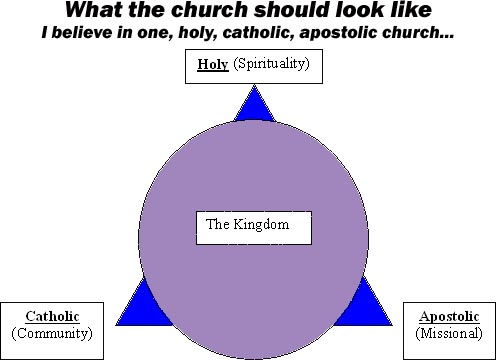
Community—we create a place of belonging where people learn to believe the good news, belong to a group that is learning to live by that good news, and become (together) a living example of it. We are unified and connected to one another, maintaining the humility and gentleness necessary for unity to flourish. We accept anyone whom Christ accepts, without favoritism or judgment.
Spirituality—this is the “holy” part of the creed. But it is not just about individual spirituality, but communal. Our failures and our successes affect the church. What we experience with God in secret must be shared with the community. We read the Bible together, always listening for insights and input of others. We pray as a community, our individual prayers merging with our brothers and sisters. We worship and celebrate together, cherishing God’s faithfulness to His people. In these and other ways, through private and communal spiritual disciplines, we become set apart, holy people. We become disciples, not just followers.
Mission—this is the “apostolic” dimension of the church. Spirituality and Community naturally flow into mission. Since our needs (spiritual and physical) have already been met in through the other two, we are not free to focus on the needs of the world. We can serve instead of being served. We can reach out to the sick, and not the healthy.
The Kingdom—these three aspects of the church focus on manifesting the kingdom of God, the reign of God, and the reality of God’s will being done on this earth. The church is the catalyst for bringing about the Kingdom. A “successful” church is not the end goal. Rather, the goal is for every Christian to be sent out as an agent of Christ (priesthood of all believers), an agent of the Kingdom to bring peace between God and His creation.
******************
Notice there is little new to this model, and the fact that it is a model makes it more modern than post-modern. But I suppose it is more of a vision than an exact plan on how to do things. You may think that this is not original at all. And perhaps you are right. But I ask, how many of our churches actually embody such a model? How many of our churches reflect Jesus’ teachings and the practice of the early church? Few to be sure.
But if our churches were to buy into this vision, I think we would see a marked change in their effectiveness and the impact of the Kingdom in this world. Each church may fulfill and go about these ideals differently, but I believe the end result would be the same—unity and the bearing of much fruit. Christians would make a difference, cease feeling like hypocrites or useless. Their faiths would not be futile, but have purpose and vitality. The church would no longer be an exclusive club of sorts, but a life-giving vessel in God’s hands. But perhaps it is just a dream. Perhaps it cannot occur. Only time and patience will tell.
Thursday, February 17, 2005
A New Kind of Christian Part 4 - Faith Foundations

At one point, McLaren compares faith not to a building with a foundation, but to a spider web with many anchor points. These anchors may be spiritual experiences, exemplary people we have come to trust, or guidance and teaching from a variety of sources. The great thing about a web is that it is both flexible and resilient. It can be repaired when damaged. It serves various functions.
And the Bible is also an anchor point in this web of faith. Though many people call the Bible the foundation, in reality, Jesus is the foundation, not the Bible. To be more specific, every passage from the Bible that has affected your life could be seen as not just an anchor point, but part of every thread on the web.
And when it comes to the interpretation of the Word, there are problems on both sides of the spectrum:
Conservatives treat the Bible as if it were a modern history book, encyclopedia or law code. But those sorts of categories were rudimentary at best, and you can’t discount the clear difference in what was written then and what is written now.
Liberals, though they acknowledge that the Bible is different from modern texts, still seem to judge it by modern standards. If something in the Bible doesn’t fit in with a Western mindset (objectivity, science, democracy, individualism, etc.) then it is dismissed as primitive or irrelevant.
Wednesday, February 16, 2005
A New Kind of Christian Part 3 - Biblical Interpretation
Today’s topic is of special interest to me. I have long struggled with expressing my view of how I approach the Bible and then how interpretations might stem from that view. Systematic theology and wooden, literal views on the Bible have never quite settled well with me, especially as I gain a better understanding of the nature of the literature. Mclaren did what I could not. He worded this tension that I had between not having to believe every single word as literal without relativizing it. Interesting thoughts to be sure.
The conservatives are against reinterpreting ancient wisdom in light of contemporary fads or moods, and they’re against weakening the strong, unchanging backbone of the faith, fearing that we’ll be left with a kind of jellyfish spirituality that has nothing to cling to.
Meanwhile, the liberals are against pitting faith against honest scientific investigation and turning faith into an anti-intellectual enterprise. They’re against the resistance to free inquiry and against the privitization of faith. They think that conservatives have retreated to their own private sphere, worrying only about their own personal salvation, leaving the world at large to go to hell ecologically, culturally, and in terms of social justice.
Both sides are against something worth being against.
Often conservatives will say that the Bible is the foundation for everything, and tampering with the foundation causes the whole structure to come down. Thus often the view, from the conservative point of view, is that the liberals are throwing out the Bible and everything that does not appeal to them. Yet, conservatives do the same thing, often unaware:
Conservatives don’t impose the penalties of stoning to death for those who disobey their parents.
They don’t exclude from the worship service anyone whose genitals have been mutilated.
They don’t teach that it is a sin for women to wear jewelry or have a short haircut.
They don’t follow the example of many OT characters such as killing infidels, having many wives, or killing their enemy’s babies.
And why not? Because they approach the Bible with a particular framework that keeps them from applying the Bible literally in such situations. The difference between the liberals and the conservatives is the interpretive framework. But the conservatives often seem unaware of such a framework, and think they are rigorously applying the Bible literally. Thus, when conservatives argue about the Bible’s absolute authority they are arguing about the superiority of their traditional framework through which they read and interpret the Bible.
This does not mean that the Bible is not authoritative. But real authority lies in God, who is there behind, beyond, and above the text, not in our interpretations. The authority is not in what I say the text says, but in what God says the text says. Our interpretations reveal less about God or the Bible than they do about ourselves. They reveal what we want to defend, what we want to attack, what we want to ignore, what we’re unwilling to question. The issue to be considered does not revolve around a book that we can misinterpret with amazing creativity but rather with the will of God, the intent of God, the desire of God, the wisdom of God—the Kingdom of God.
The Bible says of itself, that Scripture inspired by God and authoritative. It is useful as well—to teach, rebuke, correct, instruct us to live justly, and equip us for our mission as the people of God. That is a very different approach than how many take the Bible. We want the Bible to be God’s encyclopedia, God’s rule book, God’s answer book, God’s scientific text, God’s easy-step instruction book, God’s little book of morals for all situations.
But think of a math book. It is not valuable because the answers are in the back. It is valuable because, by working through it, by doing the problems, but struggling with it, you become a wiser person, capable of applying those truths in a variety of ways.
Tuesday, February 15, 2005
A New Kind of Christian Part 2 - Debate
Debates in the church occur on what McLaren calls the “line level.” I have found his insight into this matter to be quite helpful:
There are all kinds of positions on an issue along this line, with the most extreme positions being on the ends. The issue often is, “Where is the right point on the line?” So people pick and defend their points. Each person’s point becomes the point in his or her mind. But what if the point-defending approach is, pardon the pun, pointless? What if the position God wants us to take isn’t on that line, but somewhere up above it?
This illustration really struck a chord with me, being one who is often sucked into debates. I try to be in the middle, and see both sides of the argument. But in reality, I need to not just be in the middle, but be up above the debate. For unity to occur among our people and in our churches, we need to transcend the normal level of debate. Jesus did it all the time. Take for example the discourse with the Samaritan woman. The debate began with where people should worship. She cited two points on the line in the form of two mountains—here on Mt. Gerazim or there in Jerusalem. Back in those days, this was not some arbitrary matter of debate. The location of the very presence of God was at stake. But Jesus would not pick one or the other. The answer to such a question was on a different level, for God desires worshipers in Spirit and truth regardless of the mountain. Thus both mountains are acceptable just as both sides are acceptable. Neither is right and neither is wrong.
This sort of thinking often scares modern people who desire absolute truth, clear boxes and lines, and standards of correct and incorrect. But I ask, is that Biblical? Jesus came to fulfill the law, and by that, it seems, to take the law (and the interpretation of it and the Bible as a whole) to a higher level. The Pharisees would have made great modern believers because of their desire to pigeonhole and make a framework to work within. But even the Bible is full of exceptions, not always clearly delineated rules. I, of course, am not advocating any and every view, interpretation, or belief. But, there are so many debates that, if taken to a higher level, would be far more productive. Think how differently a conversation about Calvinism, charismatics, pacifism, inerrancy of the Bible, women in leadership, and homosexuals would go if it was not about proving someone wrong but instead focused on moving to a higher plane.
Monday, February 14, 2005
A New Kind of Christian Part 1

This week is officially “Postmodern Christianity week” here at the Second Call. I just finished reading through A New Kind of Christian by Brian McLaren. Basically he is the spearhead behind a new “movement” called the emergent church. I had an entry earlier about this movement. This emerging church is the first real attempt that seems successful in bringing the church into the postmodern world. The book is actually more of a dialogue between two people, one is a struggling pastor and the other is an aged Jamaican, ex-pastor, high school science teacher. I didn’t like the extra personal stuff in the dialogue, so I have mined out the best concepts for this prose entry. But I did like the real questions that a man steeped in modernity had for someone struggling to bring postmodernity into the world. I have had the same questions as I struggled with my own faith in the last few years. This entry compares the difference between the current church and the emerging church. (note: his comments are italicized)
***********************************************
Moderns often feel the need to put everything into nice neat categories, which is part of the problem. They believe that they could create a nice framework that would pigeonhole everything. But if you try to categorize this postmodern church and you succeed in creating a postmodern framework, I think you’ve just sabotaged it. We’re talking about a new kind of Christian, not the new kind or a better kind or the superior kind, just a new kind.
At various times he likens this transitional period to the time when the world went from the medieval to the modern period. It was difficult to be sure. But eventually, people realized that if they did not move forward, they would be left behind. McLaren poses two striking questions:
Will you continue to live loyally in a fading world, in the waning light of the setting sun of modernity? Or will you venture ahead in faith, to practice your faith and devotion to Christ in the new emerging culture of postmodernity?
Great thinkers like Luther both embraced and facilitated the change from medieval to modern, and yet remained true to the past. That is the tension and the greatest difficulty. How do you move ahead without alienating and ignoring all that has gone before you? If your desire is to forge ahead, McLaren gives a few things to keep in mind:
Don’t put your confidence in the institution of the church; put your confidence in God
Be open to new ideas and new interpretations of the faith
Don’t be too quick to criticize
Expect things to be messy
Keep going back to the Bible, but not with the standard interpretations blinding you to new interpretations
Try to sort out tradition from the real essentials of the gospel
Whether you are postmodern or not, I think those are guidelines are important in dealing with people in general, and especially people in the church. He concludes this sort of thinking with a challenge:
I want you to invest your lives not in keeping the old ship afloat but in designing and building and sailing a new ship for new adventurers in a new time in history, as intrepid followers of Jesus Christ.
How much are you building and how much are you maintaining? Are you beating the same old path down or are you blazing new ones?Saturday, February 12, 2005
A little rest and relaxation
I’ve finished reading through Leviticus, and though most find it pedantic, I am intrigued by the minutia of ways to properly approach God. One of the main points that is stressed revolves around properly balancing work and worship. That is one reason God instituted the Sabbath day: “There are six days when you may work, but the seventh day is a Sabbath of rest, a day of sacred assembly. You are not to do any work; wherever you live, it is a Sabbath to the LORD” (Lev. 23:3). Yahweh required that one day be set aside as an act of worship to Him. But more than that, it was a day of refreshment for the people.
Even the entertainment industry realizes the necessity of such a provision. I just saw a great commercial today. It features a sophisticated man sitting in a chair. All the walls behind him have Rx on the, and he says:
“The pharmaceutical industry applauds this nation’s obsession with career advancement. Thanks to your inability to balance life with work, sales are through the roof. Indeed 45% of Americans don’t use all their vacation time—a proven cause of stress induced illness and depression. So stay the course. As long as you are committed to all work and no play we’ll provide happiness in the form of a pill.”
The commercial ends with cool shots of roller coasters and families having fun, and the statement: “Logon to UniversalOrlando.com.”

From Leviticus and the Universal commercial, I am reminded of a few things. God has set up the system so that we do not spend out entire lives selfishly working. When we do we become ineffective. More than that, God does not receive the proper attention that He deserves. We try to make up for our overly stressed lives with drugs to give us more energy. Or perhaps worse, we substitute giving God our best with giving him the best we can spare.
But the Sabbath day was meant to be a rest from the trials of life so that the Israelites could focus on God’s faithfulness to them. It was meant as a day of refreshment—physically and spiritually. And though, as Christians, we do not have a Sabbath day, and I don’t equate church with the Sabbath, if we do not have these times dedicated to God for Him to refresh us, we will end up giving Him a contrived substitute. So let us remember to keep the Sabbath, and keep our relationship with God fresh.
Even the entertainment industry realizes the necessity of such a provision. I just saw a great commercial today. It features a sophisticated man sitting in a chair. All the walls behind him have Rx on the, and he says:
“The pharmaceutical industry applauds this nation’s obsession with career advancement. Thanks to your inability to balance life with work, sales are through the roof. Indeed 45% of Americans don’t use all their vacation time—a proven cause of stress induced illness and depression. So stay the course. As long as you are committed to all work and no play we’ll provide happiness in the form of a pill.”
The commercial ends with cool shots of roller coasters and families having fun, and the statement: “Logon to UniversalOrlando.com.”
From Leviticus and the Universal commercial, I am reminded of a few things. God has set up the system so that we do not spend out entire lives selfishly working. When we do we become ineffective. More than that, God does not receive the proper attention that He deserves. We try to make up for our overly stressed lives with drugs to give us more energy. Or perhaps worse, we substitute giving God our best with giving him the best we can spare.
But the Sabbath day was meant to be a rest from the trials of life so that the Israelites could focus on God’s faithfulness to them. It was meant as a day of refreshment—physically and spiritually. And though, as Christians, we do not have a Sabbath day, and I don’t equate church with the Sabbath, if we do not have these times dedicated to God for Him to refresh us, we will end up giving Him a contrived substitute. So let us remember to keep the Sabbath, and keep our relationship with God fresh.
Friday, February 11, 2005
Relief Reluctance
I saw a special on MTV the other day about the aftermath of the Tsunami in India, Sri Lanka, Indonesia, and Thailand that was very well done. But it got me thinking. There have been two major disasters in the last few years that have had an impact on me—the terrorist hijack bombings on 9/11 and now this tsunami. Both times I have felt compelled to do something to help out. And I suppose it is fine to send money and pray, but I really have felt led to do more.

As I saw the MTV special, there were college kids in Thailand helping sort through the rubble to rebuild. I thought, “Why couldn’t that be me?” Then I remembered: I have a kid now. I have a wife. I have a job at the church. All these responsibilities are my top priority. I don’t begrudge them, because they do bring joy to my life. But I can’t help but think of Paul’s advice to those seeking marriage: “I would like you to be free from concern. An unmarried man is concerned about the Lord’s affairs—how he can please the Lord” (1 Cor. 7:32).
It is not just marriage, but growing up, becoming an adult, living in the real world that bring about responsibilities that often hinder our ability to serve those in need. And I wonder, is the system flawed? Are we too engrained in our own selfishness that being an adult means being unable to really help out? Or do we just make excuses?
Either way, every time I see aid going to help out disasters it makes me think: “Why isn’t that me?”
As I saw the MTV special, there were college kids in Thailand helping sort through the rubble to rebuild. I thought, “Why couldn’t that be me?” Then I remembered: I have a kid now. I have a wife. I have a job at the church. All these responsibilities are my top priority. I don’t begrudge them, because they do bring joy to my life. But I can’t help but think of Paul’s advice to those seeking marriage: “I would like you to be free from concern. An unmarried man is concerned about the Lord’s affairs—how he can please the Lord” (1 Cor. 7:32).
It is not just marriage, but growing up, becoming an adult, living in the real world that bring about responsibilities that often hinder our ability to serve those in need. And I wonder, is the system flawed? Are we too engrained in our own selfishness that being an adult means being unable to really help out? Or do we just make excuses?
Either way, every time I see aid going to help out disasters it makes me think: “Why isn’t that me?”
Tuesday, February 08, 2005
Entertainment and Evangelism

I have always been a big fan of The Simpsons. It is (in my opinion) the most relevant and thoughtful show on television. The commentary that it makes on society is insightful and desperately needed as more and more people act without much aforethought.
If you missed the new episode after the Super Bowl, you missed a classic. There was plenty going on such as decrying the outbreak of showboating and taunting. But the forefront of the show revolved around the result of when religion meets Hollywood. The reactions that came from “The Passion” were varied and often at odds. Some thought that Jesus finally got the recognition he deserved. Others thought anti-Semitism was never crueler. Still others were offended that anyone dared to ruin entertainment with some sort of actual moral influence.
With this in mind, Homer was asked to do the Super Bowl halftime show, and after having no ideas, enlisted the help of Ned Flanders (token Jesus Freak). Together they told the story of Noah in glitzy fashion. The reaction was not good. Boos echoed from the crowd. But the cleverness of the show was the commentary from the news desk:
Ken Brockman (Anchorman): “All over America today, viewers were outraged by the Super Bowl halftime shows blatant display of religion and decency.”
Mother on the street: “You try to raise your kids as secular humanists, but these showbiz types keep shoving religion down our throats.”
Little boy: “Mommy why wasn’t I baptized?”
Mother: “You see. You see!”
Homer: “I thought America was hungry for meaning. I should have just sent a crocodile into space like I originally planned.”
Yes Homer, perhaps you should have stuck with the crocodile. But it leads me to wonder—how do you reach an individualistic society that requires a laissez-faire attitude regarding morality and decency? Should more movies like “The Passion” be made without regard to who may be “offended” by the gospel? Or should do more following the advice of Saint Francis and “Preach the gospel. If necessary, use words.”
An interesting quandary. Any thoughts on the matter are appreciated.
Life as I know it
Well, I had something planned for today, but my day yesterday was wiped out with therapy, and the first church league playoff game. So I thought I would fill you in on my current situation. The therapy is for my back (not my mental state). I currently have a pinched nerve caused by arthritis in my lower back. The only hope for a solution—work it out through the physical therapy. Not a lot of hope there. I have been going for a few weeks and doing my painful stretches, and it has not gotten better. Of course, I do still play basketball, which probably doesn’t help matters, but I am too competitive to stop.
Speaking of which, I will now stop playing basketball because we lost our opening game by 3 points. Quite a barn burner I suppose. Now, I don’t like losing during the regular season, but I can handle it. But in the playoffs, when it is 1 and done, I get very frustrated. It is so final. I mean, that is it. I’ve got nothing until next December except pick up games with dog. Not so fun. Oh well, that is the way it goes.
On the Elijah front, he had another “well baby” visit yesterday. He is 28 inches long (95th percentile) almost 19 pounds (75th percentile) and a pretty good sized head (75th percentile). He does have an ear infection, but we received some drugs to help clear that up. Carrie and I are worried, however. The flu has hit our state, and is nearing our region. Carrie’s proximity to children and possible exposure has our guards up. I suppose there will be plenty of hand washing for the next few weeks.
Check back tomorrow for some good stuff from The Simpsons.
Speaking of which, I will now stop playing basketball because we lost our opening game by 3 points. Quite a barn burner I suppose. Now, I don’t like losing during the regular season, but I can handle it. But in the playoffs, when it is 1 and done, I get very frustrated. It is so final. I mean, that is it. I’ve got nothing until next December except pick up games with dog. Not so fun. Oh well, that is the way it goes.
On the Elijah front, he had another “well baby” visit yesterday. He is 28 inches long (95th percentile) almost 19 pounds (75th percentile) and a pretty good sized head (75th percentile). He does have an ear infection, but we received some drugs to help clear that up. Carrie and I are worried, however. The flu has hit our state, and is nearing our region. Carrie’s proximity to children and possible exposure has our guards up. I suppose there will be plenty of hand washing for the next few weeks.
Check back tomorrow for some good stuff from The Simpsons.
Monday, February 07, 2005
A Foggy Death
On Saturday, I was perusing the site of my undergrad Alma Matter (GLCC), and I noticed the weather on the right hand side. It read, “Light Freezing Fog.” I had no idea what such a weather pattern looked like. It both scared and bewildered me. Then my thoughts turned to the awful reality of the situation and certain questions filled my head: 
What the hell is Light Freezing Fog!?!?
Is that where the air turns so cold that the moisture in your lungs freeze like in “The Day After Tomorrow”?
Were all of my friends in Michigan in danger of dying such a horrible death?
Was this a sign of the end of the world?

It is now Monday, and there are no reports of instantaneous death from breathing this menacing fog, but I stay vigilant. Global warming is no joke people. Don't be fooled by the Michael Creightons of the world. It's going to happen. Though many say the world will end in fire, I think it will really be in ice. Be ready.
What the hell is Light Freezing Fog!?!?
Is that where the air turns so cold that the moisture in your lungs freeze like in “The Day After Tomorrow”?
Were all of my friends in Michigan in danger of dying such a horrible death?
Was this a sign of the end of the world?
It is now Monday, and there are no reports of instantaneous death from breathing this menacing fog, but I stay vigilant. Global warming is no joke people. Don't be fooled by the Michael Creightons of the world. It's going to happen. Though many say the world will end in fire, I think it will really be in ice. Be ready.
Friday, February 04, 2005
Thursday, February 03, 2005
Paying for Oxen
Now, I am not one who thinks that allegorizing the Biblical text is a good thing. It often causes bad interpretation and completely removes the original context from view. All you have to do is read literature saying that Song of Songs is about Jesus and not about sex to know what I am talking about. That being said, when I read the following text from Exodus, my mind could not help but be moved to an allegorical interpretation. So, while it is not a good interpretation of the text, it is a good lesson nonetheless. Sorry in advance for those who find me deplorable and a traitor to my education.

“If an ox gores a man or a woman to death, the ox must be stoned. The meat cannot be eaten but the owner of the ox is in the clear. But if the ox has a history of goring and the owner knew it and did nothing to guard against it, then if the ox kills a man or a woman, the ox is to be stoned and the owner given the death penalty. If a ransom is agreed upon instead of death, he must pay it in full as a redemption for his life.” Exodus 21:28-32
When I read it, I couldn’t help but see myself in that bit of law. No, I don’t own an ox, and have never seen an actual goring. But, replace “ox” with “sinful nature” and reread the text. I have committed sins against others (not murder, but that’s not the point). I know that I have a tendency to sin, but yet at times, my sinful nature wanders around unfettered and unabated, wreaking havoc wherever it goes. And the consequences of sin are clear—death. Death of both the sinful nature and my physical body is the sentence handed down.
But then a third party comes in to arrange a settlement. God intervenes and reaches a settlement on behalf of his people. Death, for me, the offender, is no longer the sentence. Death must still be paid out, but it is His Son that dies. And death must still come to the ox, my sinful nature, since it is the offender. All that discussion of “death to self” in the NT is not just talk. It is necessary to make the ransom binding. The sacrifice is not just on God’s part, but on ours as well. And the result—our redemption; our salvation. Praise be to God, who has paid our ransom!
“If an ox gores a man or a woman to death, the ox must be stoned. The meat cannot be eaten but the owner of the ox is in the clear. But if the ox has a history of goring and the owner knew it and did nothing to guard against it, then if the ox kills a man or a woman, the ox is to be stoned and the owner given the death penalty. If a ransom is agreed upon instead of death, he must pay it in full as a redemption for his life.” Exodus 21:28-32
When I read it, I couldn’t help but see myself in that bit of law. No, I don’t own an ox, and have never seen an actual goring. But, replace “ox” with “sinful nature” and reread the text. I have committed sins against others (not murder, but that’s not the point). I know that I have a tendency to sin, but yet at times, my sinful nature wanders around unfettered and unabated, wreaking havoc wherever it goes. And the consequences of sin are clear—death. Death of both the sinful nature and my physical body is the sentence handed down.
But then a third party comes in to arrange a settlement. God intervenes and reaches a settlement on behalf of his people. Death, for me, the offender, is no longer the sentence. Death must still be paid out, but it is His Son that dies. And death must still come to the ox, my sinful nature, since it is the offender. All that discussion of “death to self” in the NT is not just talk. It is necessary to make the ransom binding. The sacrifice is not just on God’s part, but on ours as well. And the result—our redemption; our salvation. Praise be to God, who has paid our ransom!
Tuesday, February 01, 2005

Passing the Buck
My background is in the Christian Churches/Churches of Christ. No matter where I go, someone often has something bad to say about the Catholic Church, or specifically the pope. They can’t understand why one man makes decisions, dispenses theology, becomes “god” for the followers. And yet, it seems that the criticism of the Catholic Church might be better directed at the Christian Churches as well. No, there is no infallible Pope, but there are many church members that look to the Senior Minister for all of their spiritual growth and direction. At some point, we look not to God, but to man for answers to spiritual matters. But such a thing is nothing new. It has been happening since the Yahweh revealed Himself to the Israelites. From Exodus 20:18-21:
“All the people, experiencing the thunder and lightning, the trumpet blast and the smoking mountain, were afraid—they pulled back and stood at a distance. They said to Moses, 'You speak to us and we’ll listen, but don’t have God speak to us or we’ll die.'
Moses spoke to the people: 'Don’t be afraid. God has come to test you and instill a deep and reverent awe within you so that you won’t sin.'
The people kept their distance while Moses approached the thick cloud where God was.”
Now granted, the sight of God revealing Himself would have been unbelievable and scary. But one might think that the faith of those in attendance would be bolstered. Instead, it caused wavering on the part of the Israelites. They were invited into the presence of God to receive His Words, and they retreated. They didn’t want any part of God. “Don’t have God speak to us. You do it Moses.” And so, Moses went up and got the Law.
That wasn’t what God wanted. I don’t think He wanted to present His Law to them through a third party. He wanted to do it directly, face to face. As Moses said, this would cause awe in the people. Perhaps they would be less likely to sin if God Himself presented them His requirements. But they wanted no part of it, and Moses dutifully did his part, and in the end, the Israelites did not respond to God’s Law as He wanted.
And in our churches, I see members who don’t really want to be in the presence of God. Perhaps they are scared of what will happen, of what God will ask of them. Perhaps it is just easier to allow others to deal with God while they reap the benefits. Perhaps in their eyes, the work is not worth the reward.
I don’t know what keeps people from really interacting with and experiencing this amazing God. But when we rely on others to do all of the interacting with God, we miss the deep reverence and awe. We fail the test. And perhaps, we end up failing God by being more prone to sin.
“All the people, experiencing the thunder and lightning, the trumpet blast and the smoking mountain, were afraid—they pulled back and stood at a distance. They said to Moses, 'You speak to us and we’ll listen, but don’t have God speak to us or we’ll die.'
Moses spoke to the people: 'Don’t be afraid. God has come to test you and instill a deep and reverent awe within you so that you won’t sin.'
The people kept their distance while Moses approached the thick cloud where God was.”
Now granted, the sight of God revealing Himself would have been unbelievable and scary. But one might think that the faith of those in attendance would be bolstered. Instead, it caused wavering on the part of the Israelites. They were invited into the presence of God to receive His Words, and they retreated. They didn’t want any part of God. “Don’t have God speak to us. You do it Moses.” And so, Moses went up and got the Law.
That wasn’t what God wanted. I don’t think He wanted to present His Law to them through a third party. He wanted to do it directly, face to face. As Moses said, this would cause awe in the people. Perhaps they would be less likely to sin if God Himself presented them His requirements. But they wanted no part of it, and Moses dutifully did his part, and in the end, the Israelites did not respond to God’s Law as He wanted.
And in our churches, I see members who don’t really want to be in the presence of God. Perhaps they are scared of what will happen, of what God will ask of them. Perhaps it is just easier to allow others to deal with God while they reap the benefits. Perhaps in their eyes, the work is not worth the reward.
I don’t know what keeps people from really interacting with and experiencing this amazing God. But when we rely on others to do all of the interacting with God, we miss the deep reverence and awe. We fail the test. And perhaps, we end up failing God by being more prone to sin.
Subscribe to:
Posts (Atom)